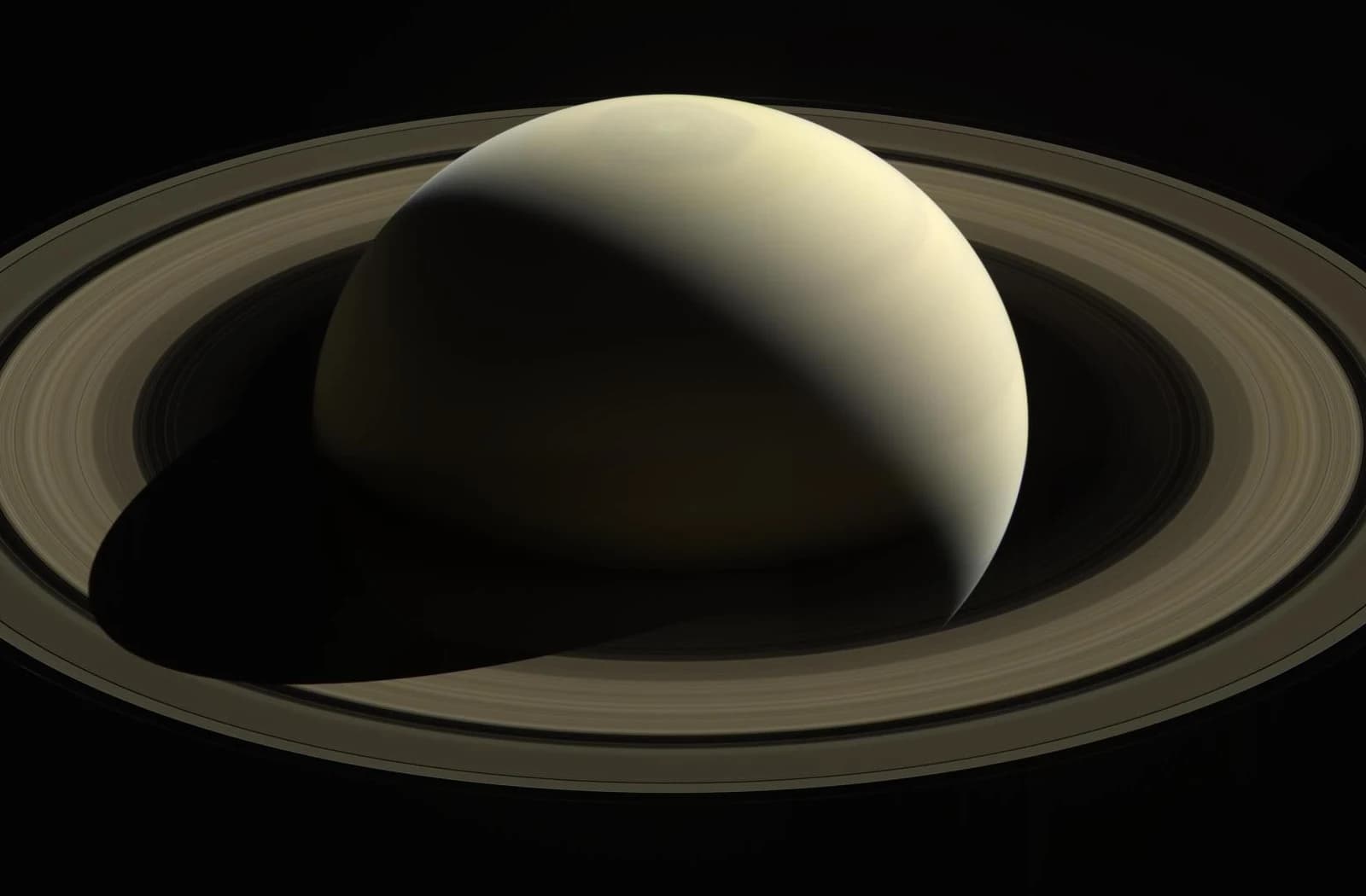
What Saturn's rings are made of
The rings contain billions of particles of ice and rocky material. They vary enormously in size, from tiny grains to large fragments. Each particle follows an orbit, so the rings should be imagined as a dynamic system. Visible light and dark bands reflect differences in structure, density, and composition.
The main regions are labeled with letters; the prominent Cassini Division lies between the A and B rings. The system's enormous width is combined with a very small thickness relative to its diameter. This geometry changes Saturn's appearance at different viewing angles. Images beautifully reveal the bands, but cannot by themselves tell the full story of their origin.
The diffuse E ring has a special connection to a moon: Enceladus supplies it with some of the ice particles ejected near its south pole. This faint outer ring should be distinguished from the bright main ring system usually shown in photographs of Saturn. Analysing individual grains helps researchers investigate both the evolution of the E ring and the composition of the moon’s ocean hidden beneath its ice.
Why the rings' age remains debated
During the final part of the Cassini mission, gravity measurements helped estimate the rings' mass. A study reported by NASA in 2019 supported a relatively recent formation scenario, long after the planet itself. Such conclusions link the measured mass to assumptions about ice contamination and the accumulation of external material.
Age is not read directly from an instrument like temperature. It is reconstructed through a model, and that model depends on material-exchange processes and the system's history. It is therefore important to preserve the wording “estimate within a study” and the result's date. Cassini data greatly improved our understanding of the rings, but a popular headline claiming that “their exact age is known” implies a certainty the science does not provide.
What ring rain means
Some ring material enters Saturn's atmosphere. Charged particles interact with the magnetic field and move toward the planet, a process called ring rain. This shows that the rings are not an eternal, completely isolated decoration. Matter is exchanged between them and Saturn.
A study presented by NASA in 2018 discussed material-loss scenarios and possible timescales for the system to change. These cannot be turned into a precise countdown: estimates use observed rates and assumptions about how those rates will persist. It is more useful to think in terms of the physical process — what is transported, where, and with what uncertainty — than a single dramatic disappearance date.
Rings and gaps: why isn't the disk solid?
The most prominent regions are labeled with letters, including A, B, and C. The Cassini Division lies between the bright A and B rings. The distribution of particles is related to their orbital motion and the gravitational influence of moons.
A dark gap in a photograph means lower reflected brightness, rather than necessarily a complete absence of material. Thin rings and faint structures require a different exposure from the bright planetary surface.
Why does the rings' appearance change?
Saturn orbits the Sun with a tilted axis. Our viewing direction from Earth toward the ring plane gradually changes: a wide oval becomes a narrow band and then opens up again.
This is a change in perspective, rather than material disappearing overnight. The rings' width and contrast in a 3D model also depend on the camera and lighting; images must be compared with the geometry in mind.
Why ring particles do not rotate as one solid plate
A ring is not rigidly attached to the planet. Its icy fragments follow individual orbits, and a complete circuit takes less time closer to Saturn than farther away. A radial line drawn across an imaginary solid disk would therefore stretch out with time. This difference in motion helps explain why the observed system contains many structures rather than behaving like a metal hoop fixed to an axle.
Letter names can also be confusing for a beginner. They reflect the history of discovery rather than a numbered sequence of distances from the planet. Moving outward, the D ring comes before C, B, and A, with fainter structures extending farther out. Alphabetical order is therefore not an itinerary. Match each name to the radius of its region and locate the Cassini Division separately.
The rings’ mass was estimated from their gravitational influence on Cassini during its final close passes. That is fundamentally different from trying to weigh rings by the brightness of a photograph. Their appearance depends on illumination, particle sizes, and viewing direction as well as the amount of ice. Comparing gravity measurements with images helps establish which distribution of material can explain the data. A detailed image locates the bands, while a gravity experiment addresses a different question: how much material is producing the measured attraction.
Sources
Questions and answers
Could you walk along a ring of Saturn?
No. A ring is not solid: its particles move independently in orbit. There is no solid path around the planet.
Is the exact date when the rings will disappear known?
No. Studies estimate material loss and evolutionary scenarios; these models do not provide an exact calendar date.