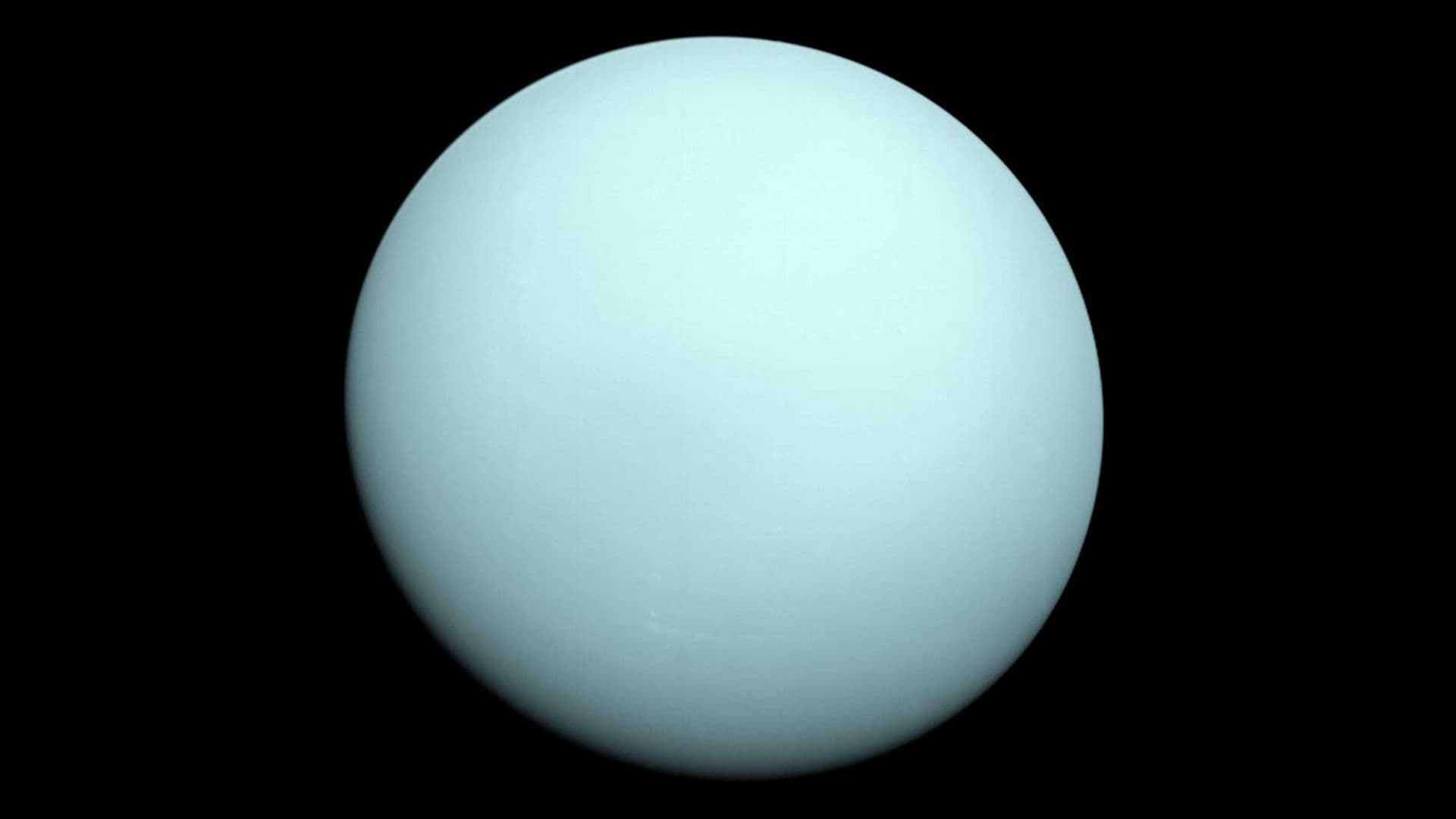
An ice giant that spins on its side
Uranus's axis is tilted by about 98°, making its rotation look like motion on its side. It appears calmer than Jupiter, but its atmosphere has structure and seasonal changes. Clouds and haze show weak contrast in visible light, while other wavelengths reveal more detail.
Uranus: key facts
- Type
- Ice giant
- Mean radius
- 25,362 km
- Mean distance from the Sun
- ≈ 19.2 AU · 2.87 billion km
- Orbital period
- ≈ 84 Earth years
- Rotation
- ≈ 17 h 14 min · retrograde
- Temperature
- ≈ −195 °C · 1-bar level
- Mass
- 8,68 × 10²⁵ kg
- Mean density
- 1 270 kg/m³
Values are rounded. The distance describes the orbit, not the current distance from Earth. For giant planets, temperature refers to a reference atmospheric level: they have no solid ground. Mean radius differs from equatorial radius.
Atmosphere and appearance
Hydrogen, helium and methane. Methane absorbs red light, while high-altitude haze softens detail.
13 rings
Narrow dark rings and faint dusty envelopes. Their brightness in infrared images differs greatly from their appearance in visible light.
Polar haze
A bright seasonal cap changes as the solstice approaches.
Deep interior 'ices'
Hot, dense mixtures of water, ammonia and methane are thought to exist inside.
What is inside?
Proposed structure. Composition changes gradually, and sharp boundaries between layers may not exist. Colors and region sizes are illustrative.
Atmosphere
Hydrogen, helium, methane and aerosol haze.
Dense envelope
A proposed hot mixture of water, ammonia and methane under immense pressure.
Heavy interior material
A likely rocky region. Its composition, size and mixing with the envelope are not precisely known.
The cutaway is based on physical models and indirect measurements. It is not a photograph of the interior; in 3D, you can select each layer separately.
Natural satellites
Its largest moons are Miranda, Ariel, Umbriel, Titania and Oberon. Their system shares the planet's unusual tilt; the faint rings are also associated with its equatorial plane.
History of discovery and exploration
March 13, 1781 · William Herschel
Uranus became the first planet discovered with a telescope. Herschel initially thought the object was a comet; its nearly circular orbit helped establish its planetary nature.
- 1781
A new planet
Herschel's observation expanded the known Solar System beyond Saturn.
- 1787
Titania and Oberon
Herschel discovered two of Uranus's large moons. Ariel, Umbriel and Miranda were added later.
- March 10, 1977
Rings revealed by a disappearing star
During a stellar occultation by Uranus, repeated drops in the star's brightness revealed narrow, dark rings.
- January 24, 1986
The only close flyby
Voyager 2 passed about 81,500 km above the clouds. It discovered ten moons and two rings.
- 2005
Outer rings
Hubble observations revealed two more outer rings and the small moons Mab and Cupid.
- 2024
Two different perspectives
Hubble and New Horizons observed Uranus simultaneously from different locations in space, helping scientists study how its atmosphere reflects light.
Voyager 2 flew past Uranus in 1986. Hubble observes seasonal changes in its atmosphere.
What the polar cap in an image of Uranus means
The bright polar region in infrared images of Uranus is not a photograph of a snowy continent. The instrument records properties of atmospheric layers in selected wavelength ranges. Uranus’s unusual tilt makes polar illumination change dramatically around its orbit, and a season lasts many Earth years. The appearance must therefore be connected to the observation date rather than treated as the planet’s permanent painted surface.
Webb reveals structures that have little contrast in familiar visible-light views. A fair comparison needs matching orientations and information about the filters used. Extra detail in an infrared image does not mean that Uranus suddenly became more active at the instant of observation. Some differences appear because the new instrument is sensitive to a different physical signal, not because the planet abruptly changed its character.
Why an ice giant is not an enormous ice cube
The class name relates to planetary composition and the importance of materials described as volatile ices in the context of system formation. It does not mean that the entire interior resembles a frozen lake. At enormous pressures and temperatures, water and other constituents behave differently from everyday materials. A familiar drawing of an icy crust can therefore be misleading if transferred directly to Uranus’s deep interior.
Interior models use the planet’s mass, size, rotation and gravity measurements. The available evidence does not uniquely determine every depth, however: different distributions of material can sometimes fit part of the same data. Distinguish a measured property from a probable explanation. A radius can be constrained observationally, whereas a detailed boundary between proposed layers requires modelling and remains a subject of investigation.
Why faint rings look prominent in scientific images
To display faint rings, observers can choose wavelengths, exposures and processing that make them stand out against the planet. The brightness balance in the published image need not reproduce a human visual impression. Read the caption carefully when the same Uranus appears smooth in one view but surrounded by crisp ring lines and conspicuous moons in another. The difference may describe the measurement and presentation rather than a transformation of the system.
Webb views of Uranus can also contain objects far in the background. Proximity in a flat image does not make every point a moon. Labels or position comparisons from different dates are needed to distinguish them reliably: moons share the planet’s system of motion, while background stars and galaxies behave differently. One photograph records directions but does not independently measure the depth of every object in the scene.
Confirming that the object you found is Uranus
A distant planet seen through a small instrument does not display the detail familiar from spacecraft images. Begin with a precise chart for your chosen time and identify the surrounding star field securely. A bluish tint in one point is not sufficient confirmation: perceived colour depends on your eyes, the object’s altitude and the optics. Establish the correct position before assessing whether a small disc can be distinguished.
Return to the field after a suitable interval and compare the planet’s position relative to the stars with a calculated chart. This demonstrates a planet’s motion among the stars, but calls for care: the whole sky turning during one night is different from Uranus changing position against the stellar background. Keep dated records that include reference stars so that the two kinds of motion do not become confused.
Questions and answers
Why is Uranus blue-green?
Methane in the atmosphere absorbs some red light. The final color also depends on haze, lighting and image processing.
Does Uranus have rings?
Yes. They are much darker and less prominent than Saturn's rings. Faint structures in scientific images are often shown with enhanced contrast.
Who discovered Uranus?
William Herschel observed the object in 1781. Determining its motion showed that it was a new planet; its faintness had previously made its nature difficult to recognize.
Continue exploring
The model offers a cutaway, rotation, images and a flight through a reconstructed environment. You can read the information on this page without loading 3D.
Open in the journeyAll planets and the Sun