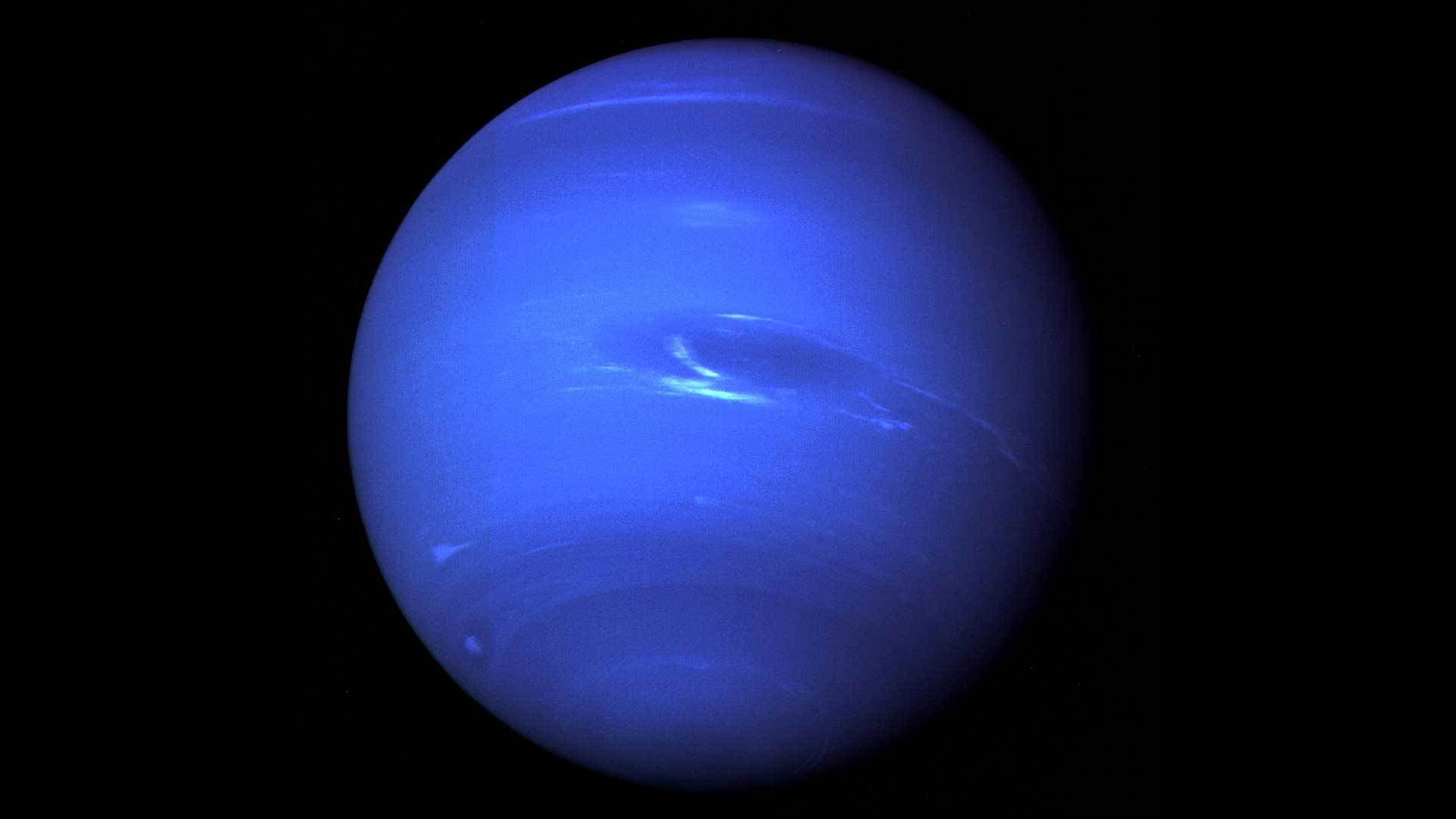
Winds at the edge of the planetary system
Neptune completes the sequence of eight planets. Sunlight is weak here, but the atmosphere remains highly dynamic. Its discovery combined calculation with observation: irregularities in Uranus's motion helped determine where to search for an unknown world.
Neptune: key facts
- Type
- Ice giant
- Mean radius
- 24,622 km
- Mean distance from the Sun
- ≈ 30.1 AU · 4.50 billion km
- Orbital period
- ≈ 165 Earth years
- Rotation
- ≈ 16 h 6 min
- Temperature
- ≈ −200 °C · 1-bar level
- Mass
- 1,02 × 10²⁶ kg
- Mean density
- 1 638 kg/m³
Values are rounded. The distance describes the orbit, not the current distance from Earth. For giant planets, temperature refers to a reference atmospheric level: they have no solid ground. Mean radius differs from equatorial radius.
Atmosphere and appearance
Hydrogen, helium and methane. Methane ice clouds move in winds reaching 2,000 km/h.
Dark spots
Atmospheric vortices appear and disappear; the spot seen in 1989 has already vanished.
Rings and arcs
Five main rings, including the Adams ring with its denser arcs.
Triton
This large moon orbits against the planet's rotation; Voyager observed plumes of material on it.
What is inside?
Proposed structure. Composition changes gradually, and sharp boundaries between layers may not exist. Colors and region sizes are illustrative.
Atmosphere
Hydrogen, helium and methane; high-altitude methane clouds.
Dense envelope
Hot, dense material rich in water, methane and ammonia.
Heavy interior material
A proposed rocky region. Measurements provide only limited constraints on its internal structure.
The cutaway is based on physical models and indirect measurements. It is not a photograph of the interior; in 3D, you can select each layer separately.
Natural satellites
Triton is Neptune's largest moon. It orbits opposite to the planet's rotation and differs from most large regular moons. Neptune also has a faint ring system.
History of discovery and exploration
September 23, 1846 · Johann Galle
Neptune was found through mathematical prediction. Urbain Le Verrier and John Adams independently calculated the position of an unknown planet from deviations in Uranus's orbit; Galle found it using Le Verrier's calculations.
- 1612–1613
Seen but not recognized
Galileo recorded Neptune but mistook it for a star. Those observations did not yet amount to the discovery of a planet.
- September 23, 1846
Calculation became observation
In Berlin, Galle found the planet about one degree from Le Verrier's predicted position.
- October 10, 1846
Triton
William Lassell discovered Neptune's largest moon soon after the planet itself was found.
- August 25, 1989
Voyager 2
The only close flyby revealed atmospheric vortices, rings and Triton's unusual icy surface.
- 2022
Webb's infrared view
Webb revealed the rings and bright cloud regions. The infrared image brings out details invisible to the human eye.
Voyager 2 visited Neptune in 1989. Ground-based telescopes and Hubble monitor its weather.
Why Neptune is photographed over decades
One portrait of Neptune records its clouds at a particular moment. Understanding the weather requires repeated observations: the formation, movement and disappearance of structures cannot be recovered from one attractive photograph. Researchers compare wavelengths, orientation, scale and instrument sensitivity. Without those checks, a difference between cameras could easily be mistaken for a change in the atmosphere itself.
A long-term observing study presented by NASA in 2023 found a link between cloud abundance and solar activity. The proposed explanation involves ultraviolet radiation affecting atmospheric chemistry. That is especially interesting for such a distant planet, but it does not turn every cloud feature into a direct indicator of the Sun’s current sunspot count. The inference depends on comparing an extended record rather than matching one pair of pictures.
What a wind speed means in a Neptune image
A wind speed cannot be measured by placing a ruler along a white streak on the disc. A cloud feature must be tracked in several images, the interval between them established, and the geometry of a rotating sphere accounted for. Its motion is then assessed relative to a chosen reference system. A large quoted speed is therefore the result of analysis rather than an impression created by an elongated cloud.
A cloud is not necessarily a permanent marker. It can form, disperse and change contrast, so a dependable result needs a sequence of observations and checks that the same feature has been identified. This also helps you read Neptune animations: a sped-up sequence combines observing times at a selected playback rate. It is not what someone would watch in real time through a spacecraft window.
What Triton’s retrograde orbit suggests about the past
Triton orbits opposite to Neptune’s rotation. This does not mean that it moves backwards across Earth’s sky every night; the statement describes motion within the planetary system. Its unusual geometry supports the idea that Neptune captured an object that had previously existed independently. A present-day orbit can thus provide evidence about the past, even though nobody observed the ancient capture event itself.
A captured world invites comparison with Kuiper Belt objects, including Pluto. Similarities do not make them copies, however: composition, terrain, atmosphere and dynamical history must be compared separately. When studying a Triton photograph, do not transfer Pluto’s place names to superficially similar pale regions. Visual resemblance suggests a question; evidence for the same underlying processes requires measurements.
Why a large planet looks so small
Neptune is much larger than Earth, but its distance makes its apparent disc small for an observer here. Angular size determines how much detail an instrument can resolve. The planet’s enormous physical scale does not guarantee an elaborate view through a small telescope. For a first search, an accurate position among the stars and a steady image matter more than an advertised maximum magnification.
Mean distance from the Sun and present distance from Earth are different quantities. Both planets change position in their orbits, so one rounded reference value is not an exact distance for tonight’s observation. Check the date and time in a sky chart, and the observing time and wavelength in a scientific image. This connects the geometry of a distant world with what the observation has actually measured.
Questions and answers
Is Neptune really so dark blue?
Some well-known Voyager 2 images have enhanced blue color and contrast. Modern reconstructions of natural color show a lighter shade, closer to blue-green.
Why does Neptune have strong winds?
The atmosphere transports energy and material despite weak sunlight. Observations show very high speeds, but a precise account of the processes requires physical models.
Can you walk on Neptune's surface?
There is no familiar solid ground. COSMO360's flight is a reconstruction of an atmospheric environment, not a photograph or a feasible human walk.
Continue exploring
The model offers a cutaway, rotation, images and a flight through a reconstructed environment. You can read the information on this page without loading 3D.
Open in the journeyAll planets and the SunSources and image
- NASA: object overview
- Exploration history · ssd.jpl.nasa.gov
- Exploration history · science.nasa.gov
- Exploration history · www.nasa.gov
- Exploration history · science.nasa.gov
- Exploration history · science.nasa.gov
- Exploration history · science.nasa.gov
- Exploration history · science.nasa.gov
- NASA: physical parameters
- Oxford: the natural colors of planets