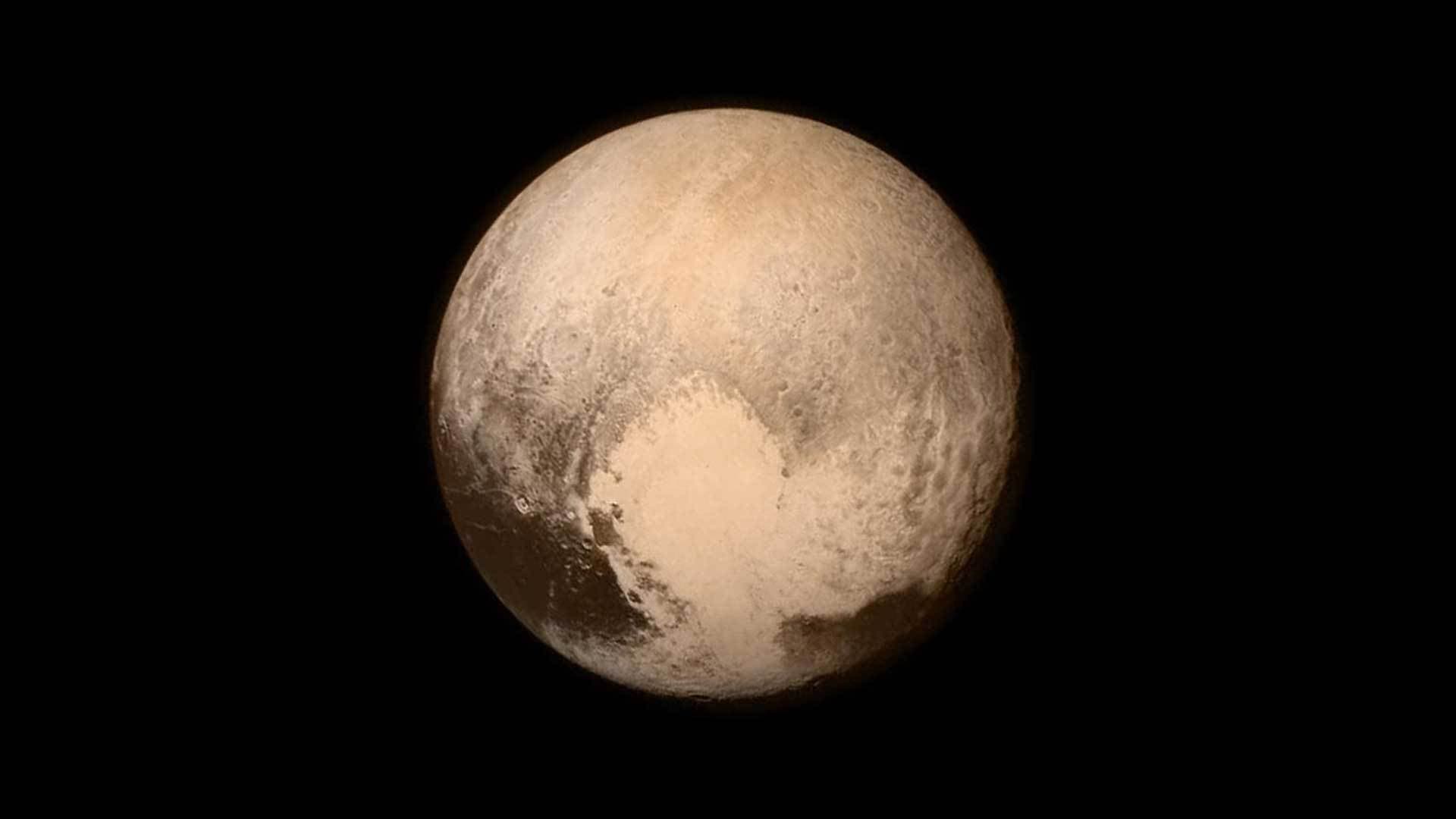
Nitrogen plains and mountains of water ice
Pluto is a complex icy world in the Kuiper Belt. Bright Tombaugh Regio adjoins dark areas, plains and water-ice mountains. Its elongated orbit produces large changes in distance from the Sun: the listed average does not describe every moment.
Pluto: key facts
- Type
- Dwarf planet
- Mean radius
- 1,188.3 km
- Mean distance from the Sun
- ≈ 39.5 AU · 5.91 billion km
- Orbital period
- ≈ 248 Earth years
- Rotation
- 6.39 days · retrograde
- Temperature
- ≈ −225 °C
- Mass
- 1,30 × 10²² kg
- Mean density
- 1 850 kg/m³
Values are rounded. The distance describes the orbit, not the current distance from Earth. For giant planets, temperature refers to a reference atmospheric level: they have no solid ground. Mean radius differs from equatorial radius.
Atmosphere and appearance
Extremely thin: mainly nitrogen, with methane and carbon monoxide. Its state depends on the sublimation and deposition of surface ices.
Sputnik Planitia
A bright plain of nitrogen ice, part of Pluto's famous 'heart'.
Ice mountains
At these temperatures, water ice forms solid mountain ranges.
Pluto and Charon
The two worlds orbit a shared center of mass; Pluto also has four small moons.
What is inside?
Proposed structure. Composition changes gradually, and sharp boundaries between layers may not exist. Colors and region sizes are illustrative.
Surface ices
Frozen nitrogen, methane and other volatile substances.
Water ice mantle
A likely icy shell. The possibility of a subsurface ocean is being investigated.
Rocky core
A proposed central region of rocky material.
The cutaway is based on physical models and indirect measurements. It is not a photograph of the interior; in 3D, you can select each layer separately.
Natural satellites
Pluto has five known moons: Charon, Styx, Nix, Kerberos and Hydra. Charon is especially large relative to Pluto; the pair's shared center of mass lies outside Pluto itself.
History of discovery and exploration
February 18, 1930 · Clyde Tombaugh
Tombaugh discovered Pluto in photographs at Lowell Observatory. The search was linked to a proposed distant planet, but Pluto's mass proved too small to explain the expected perturbations.
- 1930
A world on photographic plates
Clyde Tombaugh found a moving object by comparing photographs of the starry sky. The discovery date was February 18.
- 1930
A schoolgirl's name suggestion
Eleven-year-old Venetia Burney of England proposed the name Pluto.
- 1978
Charon
James Christy discovered Pluto's largest moon. The two bodies form a close system whose shared center of mass lies outside Pluto.
- 2006
Dwarf planet
The International Astronomical Union adopted a new definition of a planet and classified Pluto as a dwarf planet.
- July 14, 2015
New Horizons
The first close flyby revealed icy mountains, the nitrogen plain Sputnik Planitia and Pluto's complex surface.
New Horizons explored Pluto up close for the first time on July 14, 2015.
How solid ice can produce active geology
Different ices behave differently under Pluto’s conditions. Water ice can support mountainous terrain, while nitrogen ice on the plains can deform slowly under suitable conditions. “Solid” does not mean completely motionless over geological time. Explaining a landscape requires identifying the material, temperature and pressure, rather than calling everything white in a photograph snow. A familiar terrestrial word can conceal very unfamiliar physical behaviour.
The polygons in Sputnik Planitia are explained through convection in a nitrogen-ice layer: warmer material rises as cooler material descends. This is slow surface renewal, not water bubbling in an exposed lake. Computer models are compared with cell shapes, topography and composition. The polygon pattern therefore provides a test for a physical hypothesis rather than serving as a direct video record of the motion.
How Pluto’s thin atmosphere is investigated
A thin bright rim in a backlit image comes from sunlight scattered by atmospheric haze. The appearance is especially sensitive to geometry: nearly the same region can look different when the light arrives from another direction. The rim’s brightness cannot simply be converted into a familiar Earth-like air density. First, the path taken by the light through the atmospheric layers has to be understood.
During a stellar occultation by Pluto, researchers measure how the background star’s light changes as it passes through the atmosphere before disappearing behind the solid body. These events probe layers that are difficult to image directly. New Horizons also observed occultations from its advantageous nearby position. In this kind of investigation, the main result is a sequence of measurements rather than necessarily a spectacular picture of the disc.
Why Pluto’s map does not have uniform detail
New Horizons flew past Pluto rather than remaining in a long-term orbit with uniform coverage. Encounter geometry produced different levels of detail across the world, and some terrain had less favourable illumination. A map with one sharp area beside a blurry one can therefore reflect the actual data coverage. Filling the missing terrain with convincing detail would not make that invented detail an authentic observation.
Distinguish a global colour view, a high-resolution mosaic and an artistic surface reconstruction. They can be combined to explain a world, but they are not equivalent evidence. Start by locating a feature on the disc, then inspect the image scale and illumination direction. A mountain’s shadow helps reveal relief, but its length also depends on the Sun’s altitude, not just on the mountain’s height.
What the dwarf-planet classification changes
Scientific classification describes Pluto’s place among other bodies without removing its geological complexity. Judging a world’s interest only by whether it belongs to the eight planets is unhelpful: moons can also possess atmospheres, interior oceans and active terrain. A specific question is more productive, such as how heat is transported, what renews a surface, or how an atmosphere is maintained. The category frames the comparison rather than replacing the investigation.
Pluto’s elongated orbit also reminds us that ordering worlds by mean distance is not a fixed arrangement of balls. Real bodies move through three-dimensional space, while diagrams simplify scale and inclination to remain readable. Use numerical labels for size and distance, orbital diagrams for geometry, and sourced observations for terrain. Different images then need not seem contradictory merely because they were designed to answer different questions.
Questions and answers
Why is Pluto not one of the eight planets?
Under the IAU's 2006 definition, a planet must, among other criteria, clear the neighborhood around its orbit. Pluto does not dominate its orbital region in this way and is classified as a dwarf planet.
What is Pluto's heart?
This is the name given to bright Tombaugh Regio. Its western part, Sputnik Planitia, is associated with a large basin of volatile ices. It is a geological structure, not a symbol drawn on a map.
What first photographed Pluto in detail?
New Horizons obtained detailed images during its flyby in July 2015. Earlier observations from Earth and Earth orbit had much lower spatial resolution.
Continue exploring
The model offers a cutaway, rotation, images and a walk across reconstructed terrain. You can read the information on this page without loading 3D.
Open in the journeyAll planets and the Sun