Does a tenth planet exist? The short answer
As of October 8, 2026, no discovery of a tenth planet in the Solar System has been confirmed. The official list contains eight planets, while Pluto is a dwarf planet. The phrase “tenth planet” appears in popular coverage, but does not refer to an already recognized astronomical discovery.
Different ideas can lie behind this expression. Some authors habitually count Pluto and call the proposed Planet Nine the tenth planet. Others mean Planet Y, a separate hypothesis involving a less massive body. If both unknown worlds exist and receive planetary status, the total could indeed rise to ten. For now, this is a conditional scenario.
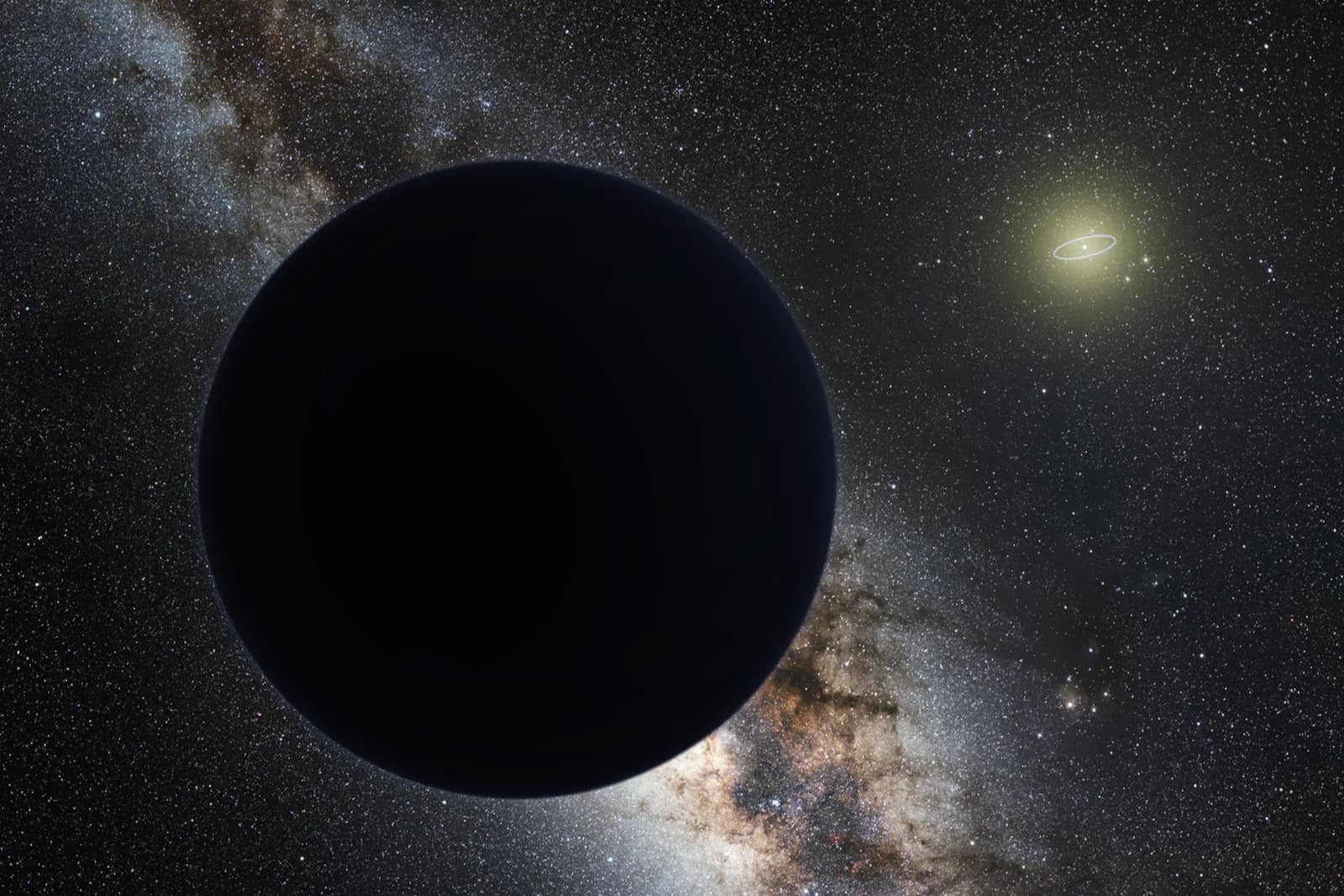
Why people refer to a ninth planet, a tenth planet, and Planet X
The confusion predates Planet Y. In 2005, the discovery of Eris, comparable in size to Pluto, prompted headlines about a “tenth planet.” In 2006, the International Astronomical Union refined the definition of a planet. Both Pluto and Eris fell into the dwarf-planet category: a rounded shape alone is not enough; gravitational dominance in the neighborhood of the orbit also matters.
The name Planet Nine refers to the hypothesis proposed by Konstantin Batygin and Mike Brown in 2016. Planet X is a historical term for an unknown planet; the X is not the Roman numeral for ten. These names help people discuss the search, but do not by themselves confirm an object's existence.
What Planet Y is and where the hypothesis came from
In a 2025 paper, Amir Siraj, Christopher Chyba, and Scott Tremaine studied the mean orbital plane of non-resonant objects in the distant Kuiper Belt. For bodies with semimajor axes of 80–200 astronomical units, they found an offset from the Solar System's invariable plane, the plane perpendicular to its total angular momentum.
One proposed explanation is the gravity of an unseen planet, which became known as Planet Y. In numerical models, a planet with a mass between Mercury's and Earth's, a semimajor axis of 100–200 astronomical units, and an orbital inclination starting at roughly 10 degrees proved to be a suitable perturber. These are parameters of a possible explanation, rather than measurements of a discovered planet.
One astronomical unit is approximately the mean distance from Earth to the Sun, about 150 million kilometers. Multiplying this by 100–200 gives a scale of 15–30 billion kilometers. The semimajor axis describes an orbit's size; it does not specify the proposed object's exact current distance.
The authors report a 96% confidence level for the offset in the 80–200 astronomical-unit interval. This refers to a statistical result of the orbital analysis, rather than a “96% probability that the planet exists.” The offset itself first needs independent verification.
How Planet Y differs from Planet Nine
The hypotheses begin from different observations. Planet Y was proposed to explain an offset in the mean orbital plane. Planet Nine is primarily sought as a possible explanation for the clustering of the orientations of some elongated trans-Neptunian orbits. The general idea is the same — detect a gravitational signature before seeing its source — but the signatures and models differ.
In Brown and Batygin's 2021 model, Planet Nine's most likely mass was about 6.2 Earth masses, with a semimajor axis of approximately 380 astronomical units. These estimates have broad uncertainty ranges. They describe a particular model, rather than an established orbit. They cannot be applied to Planet Y or combined with other calculations to describe a single supposedly discovered world.
Why an unknown planet is so difficult to see
At great distances, a planet reflects very little sunlight. Through a telescope, it would look like a faint point, rather than a large colored sphere with a visible surface. Beautiful pictures of proposed worlds are therefore artists' illustrations. They convey the idea of a distant planet, but cannot reveal its actual color, clouds, or terrain.
Another approach is to look for thermal radiation in the infrared. A 2025 study by Terry Phan and colleagues compared the IRAS and AKARI surveys, separated by 23 years, and identified one interesting candidate. The authors explicitly stated, however, that these detections were insufficient to determine a full orbit. Additional observations are needed. A candidate in images and a confirmed planet are different stages of a search.
A distant planet proposed to orbit the Sun must be distinguished from a free-floating object. Rogue planets are not bound to a host star, but faintness alone does not establish that independence. For a new source, researchers must determine its distance, motion and possible association with other bodies as well as its brightness. Discovering an isolated world elsewhere in the Galaxy therefore does not confirm an additional planet in our own system.
What changed in the research in 2026
In April 2026, Siraj, Chyba, and Tremaine presented a new method for assessing orbital-orientation clustering that accounts for uneven sky coverage by surveys. Expanding their selected sample from 21 to 25 objects reduced the clustering's statistical significance from 2.7 to 1.9 sigma. The direction of the proposed clustering was also poorly constrained. This weakens that particular argument; the paper is not a direct test of Planet Y's existence.
Lorenzo Iorio proposed another test in a paper published in 2026: use limits on changes in Saturn's orbit. His calculations substantially narrow the allowed parameters of unknown bodies. At the same time, the author emphasizes the need for a dedicated analysis of observations with the proposed planet included in the model. Such estimates constrain hypotheses, but do not replace a definitive observational test.
Why scientists do not consider the question settled
The conclusion depends on which small bodies are included in the sample, how accurately their orbits are known, and how observing directions are accounted for. A survey may find objects more often in some parts of the sky than in others. Some of the apparent pattern may then arise from the observations' design. Both celestial dynamics and the data-collection method must be analyzed together.
For example, a 2023 paper by Ian Matheson and Renu Malhotra, using a different sample and method, did not support a previously reported anomalous mean-plane offset beyond 50 astronomical units. Later studies reassess samples and approaches. These disagreements show what checks are needed: independent methods, more objects, and comparisons of models using the same data.
New objects beyond Neptune: discoveries without a new planet
In May 2025, researchers announced 2017 OF201, an object potentially large enough to qualify as a dwarf planet. Its highly elongated orbit does not fit the simple clustering picture discussed by advocates of a distant planet. It provides useful new data for testing models, but the object itself did not become a ninth or tenth major planet.
That same year, the Subaru team reported 2023 KQ14, nicknamed “Ammonite.” It belongs to a rare class of objects with perihelia far from the Sun. Its orbit also differs from those of other known sednoids. Such discoveries help reconstruct the outer Solar System's history. A single unusual object cannot automatically be treated as proof of a new planet or as a refutation of every possible model of one.
How the existence of a new planet could be confirmed
A detected candidate needs repeat observations: its positions in different images must allow a physically consistent orbit to be reconstructed. Its brightness, distance, and physical properties can then be refined. One signal resembling a prediction does not resolve all these tasks. Planetary status also depends on the body's properties and its orbital neighborhood.
Wide, repeated sky surveys, including the Vera C. Rubin Observatory's LSST program, could play a major role. These observations reveal more faint moving objects and help test the distribution of their orbits. They are useful under either outcome: if an unknown world is found, or if a more complete sample removes the need for one. There is currently no reliable discovery date.
Sources
- NASA: what counts as a planet
- NASA: the hypothetical Planet X
- Siraj, Chyba, Tremaine: the Kuiper Belt's mean plane, 2025
- Brown, Batygin: Planet Nine's orbit, 2021
- Phan et al.: a search in IRAS and AKARI data, 2025
- Siraj, Chyba, Tremaine: orbital clustering, 2026
- Iorio: constraints from Saturn's orbit, 2026
- Matheson, Malhotra: an independent analysis, 2023
- IAS: the discovery of 2017 OF201, 2025
- NAOJ / Subaru: the object Ammonite, 2025
- Rubin Observatory: exploring the Solar System
- NASA: Earth and the astronomical unit
- NASA — planets outside stellar systems
Questions and answers
Has the tenth planet already been discovered?
No. As of October 8, 2026, no tenth planet has been confirmed. Planet Y and Planet Nine remain hypotheses, and known infrared candidates require verification.
Are Planet Y and Planet Nine the same thing?
No. They were proposed to explain different features in the orbits of distant small bodies. Their proposed masses and orbits also differ.
Is there a real photograph of Planet Y?
There is no confirmed image of Planet Y as a discovered planet. Illustrations show artists' interpretations, rather than an observed surface of the object.
Why isn't Pluto considered the ninth planet?
Under the International Astronomical Union's 2006 definition, Pluto is a dwarf planet. It does not gravitationally dominate the neighborhood of its orbit in the way the eight major planets do.
When will a new planet beyond Neptune be found?
There is no well-founded date. Repeat observations and new surveys must test both candidates and statistical arguments. The result could support the hypothesis or show that an additional planet is unnecessary to explain the data.