Ribose, glucose and other sugars really have been detected in material from asteroid Bennu. This is not a discovery of RNA, DNA or organisms. Samples returned by OSIRIS-REx let scientists investigate an earlier chapter: how ordinary chemical reactions produced ingredients for biology. Studies in 2026 added information about the molecules’ origins, showing why different components of the same rock may have followed very different paths.
- The sugar study was published on 2 December 2025. Six sugars, including ribose and glucose, were identified in one sample; deoxyribose remained below the detection limit.
- Earlier work found 14 of the 20 amino acids used by Earth life to build proteins and all five canonical DNA/RNA nucleobases. This does not mean complete proteins or genetic strands were present.
- In 2026, researchers refined the inventory of nitrogen-bearing organics and possible formation pathways for glycine. Isotope data help distinguish different chemical histories.
- The samples’ strengths are controlled collection and storage, procedural blanks and the ability to repeat analyses. Even with these precautions, each method needs contamination checks.
What is new in 2026 if the sugars were found earlier
The sugar result has a specific publication date: the Nature Geoscience paper appeared on 2 December 2025. It was included in a 2026 journal volume, which does not move the discovery to autumn 2026. Publication date, volume year and laboratory work dates must be distinguished. The material itself was collected earlier still, in 2020, and delivered to Earth in 2023.
Follow-up results arrived in 2026: PNAS published an amino-acid isotope study in February, and Communications Chemistry reported a detailed distribution of nucleobases and related compounds in April. In September, an ETH Zurich team presented an isotope-based reconstruction of the origins of Bennu’s material. The broader question is moving from which molecules are in a vial to where they formed and what transformations they experienced.
How Bennu samples reached laboratories on Earth
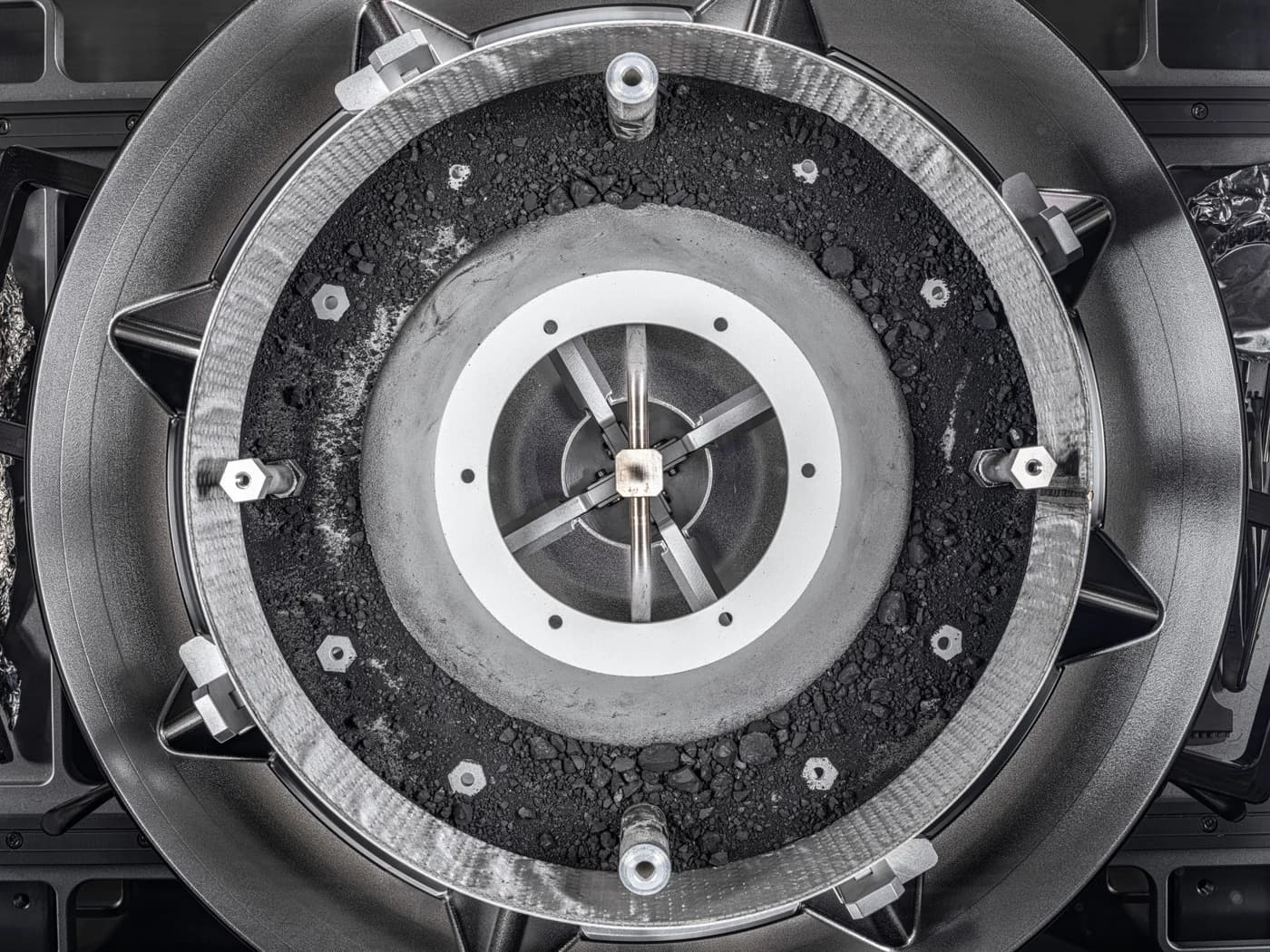
OSIRIS-REx touched Bennu’s surface on 20 October 2020 and collected rocks and dust using the TAGSAM sampler. The capsule returned on 24 September 2023, landing in Utah. The mission delivered 121.6 grams of material in total. That is the mass of the returned collection, rather than the sample used to search for sugars: individual chemical analyses use much smaller portions.
The return mission’s value lies in its documented handling history. An ordinary meteorite passes through Earth’s atmosphere, lies on the ground and encounters water, air and organisms. For Bennu, those uncontrolled stages were replaced by an engineered procedure and storage under high-purity nitrogen. This collection allows comparisons between laboratories and enables questions to be revisited with more sensitive instruments.
Exactly which sugars were detected
Yoshihiro Furukawa’s team analysed 603.4 milligrams of powdered material. The extract contained four five-carbon sugars — ribose, lyxose, xylose and arabinose — and two six-carbon sugars: glucose and galactose. Here, sugar describes a class of molecules, rather than white crystals of table sugar lying on the asteroid. Amounts were very small, at fractions of a nanomole per gram of material.
Ribose is part of Earth RNA, while glucose is used by many organisms in energy metabolism. These familiar molecules’ biological roles make the finding noteworthy. The authors did not, however, claim detections of mannose or altrose: suggestive signals were insufficiently definitive. Several other compounds, including 2-deoxyribose, remained below the detection threshold.
How molecules were identified in dust and minerals
The researchers did not search a pebble under a microscope for individual sugar molecules. They extracted soluble organics, prepared the compounds for analysis and separated them by gas chromatography. A mass spectrometer then measured characteristic fragments. The sample’s behaviour was compared with reference sugars using several criteria, and identifications were confirmed on another system with a different separation column.
Preparation also affects the result: acidic extraction conditions were chosen to limit sugar formation or degradation during the procedure itself. This illustrates why returned samples offer more than a striking image. A laboratory can separate a mixture, vary the method and examine controls, rather than infer the entire composition from a rock’s appearance.
Why this does not mean RNA or DNA was found
A nucleobase, a sugar and a phosphate group are components of a nucleotide’s chemical structure. An RNA strand requires those parts to be joined appropriately, with nucleotides forming a particular polymer. Finding components in separate analyses is different from isolating such a strand, reading its sequence or establishing its function. No such results have been reported for the Bennu samples.
The lack of detected deoxyribose also needs careful interpretation. It is a result for the tested portion and the method’s sensitivity, rather than proof that the sugar never existed anywhere in the parent body. The authors discuss ribose availability in relation to the RNA-world hypothesis. The finding informs that discussion, without establishing the particular pathway that led to Earth’s first organisms.
What amino acids and the 2026 nucleobase study added
In January 2025, Nature Astronomy reported nitrogen-rich soluble organic matter. It included 14 of the 20 amino acids used by Earth life to build proteins and all five canonical DNA/RNA nucleobases: adenine, guanine, cytosine, thymine and uracil. These belong to different chemical groups. Nucleobases are not amino acids, and individual amino acids do not constitute a complete protein.
The April 2026 study refined both the familiar nucleobase inventory and the distribution of related nitrogen-bearing compounds. The coexistence of bases used by Earth biology and their non-canonical chemical relatives supports an extraterrestrial, abiotic origin for the mixture. Ratios differed from some other asteroid samples and meteorites: a clue to starting materials and processing, rather than a discovered universal genetic code of space.
Salts record ancient water, not an ocean today
A separate January 2025 Nature paper described a mineral sequence from ancient brine: sodium-bearing phosphates, carbonates, sulfates, chlorides and fluorides. Relationships between minerals help reconstruct which compounds precipitated earlier and which later. This is a geochemical record of changing fluids inside the parent body, whose fragments eventually formed Bennu.
These findings do not mean today’s small asteroid conceals a sea or that the capsule carried a jar of liquid water. They record ancient reactions and drying solutions. Some salts change readily during prolonged exposure to Earth’s atmosphere. Controlled storage therefore preserves both organic cleanliness and the mineral record itself, which a naturally fallen meteorite can partly lose.
Sugars and glycine may have formed by different pathways
For the sugars, the authors proposed reactions in formaldehyde-bearing brines within the ancient parent body. This explanation fits the sample composition and laboratory synthesis analogues; the ancient reactions themselves cannot be observed. The measured inventory constrains scenarios more strongly than simply saying everything came from space, while still leaving conditions and formation stages open to investigation.
The February 2026 PNAS paper showed why all organics should not be assigned a single recipe. The authors measured carbon isotopes in different parts of glycine molecules. Bennu’s data differ from the Murchison meteorite and support the hypothesis that much of its glycine formed in primordial cold ices. Later aqueous processing may have preserved that isotope pattern. This interprets particular molecules, rather than establishing the history of every compound in the sample.
How terrestrial sugar contamination was checked
Protected return reduces contamination, without removing the need to look for it. The sugar study used a procedural blank: clean material went through comparable preparation and analytical steps. No sugar signals were found in it. Identifications were also checked with another instrumental setup, and the mixture was compared with plausible non-biological chemistry. These are complementary arguments, rather than a promise of absolute sterility.
There is also a limitation: the low amounts prevented measurements of the sugars’ stable isotopes and mirror-image ratios. Tests performed on amino acids therefore cannot simply be transferred to sugars. Roughly equal mirror-image proportions in certain amino acids support an abiotic origin for those compounds, but do not replace separate checks for each molecular group.
What 2026 isotope results suggest about Bennu’s origins
The September work presented by ETH Zurich addressed a different scale: iron, titanium and chromium isotope characteristics in mineral material. These help compare dust reservoirs from which early Solar System bodies assembled. The team proposed that Bennu’s precursors formed near the water-ice condensation boundary, where particles from different disk regions could mix.
This is a model for the origin of the starting material, rather than a mapped birthplace for today’s asteroid. It should be distinguished both from individual sugar chemistry and from the later disruption of the parent body. A rock can preserve ancient isotope signatures alongside evidence of aqueous processing. Calling material primitive therefore does not mean every molecule has remained unchanged for billions of years.
Why preserve samples after the first major discoveries
Each method examines a different part of the collection: soluble molecules, insoluble organics, salts or individual-element isotopes. Even a single rock can be heterogeneous, and chemical extraction selects only the fraction accessible to it. Further work requires comparisons between methods, replication and additional portions of material. A new sample paper in 2026 therefore does not mean the spacecraft has just delivered another capsule.
The spacecraft is continuing in the separate OSIRIS-APEX programme, investigating Apophis after its close Earth flyby in 2029. Bennu sample analysis, meanwhile, takes place in terrestrial laboratories. The two efforts complement each other: the spacecraft studies how an asteroid changes during an encounter, while preserved samples allow ancient chemistry to be investigated as instruments improve.
The MMX mission addresses a different sample-return question: it targets the Martian moons and plans to collect material specifically from Phobos. The returned grains are intended to help distinguish between scenarios for the small moon’s origin. Experience with Bennu demonstrates the scientific value of terrestrial laboratories and preserved samples, but one asteroid’s composition cannot be assumed for another target. Collecting, returning and analysing Phobos material remain future stages of the mission.
Sources
- NASA — collection in 2020 and capsule return in 2023
- NASA — Bennu sample mass, curation and allocation
- Nature Geoscience — sugars in Bennu samples, 2 December 2025
- NASA — ribose, glucose and other results, December 2025
- Nature Astronomy — ammonia, amino acids and nucleobases, January 2025
- Nature — minerals from ancient brine, January 2025
- Communications Chemistry — distribution of nucleobases, April 2026
- PNAS — different amino-acid formation pathways, February 2026
- ETH Zurich — isotopes and the origin of Bennu material, September 2026
- Science Advances — isotopic constraints on Bennu’s origin, 2026
- NASA — key organic and salt analysis results, January 2025
- NASA — OSIRIS-APEX and the future investigation of Apophis
- NASA — actual photograph of the opened TAGSAM sampler
- JAXA — the MMX plan to return Phobos samples
Questions and answers
Were sugars or life found on Bennu?
Molecules of several sugars were detected in a laboratory extract of returned material. Organisms were not found. Sugars can form through non-living chemical processes, so they do not by themselves demonstrate a biological origin.
Is ribose already RNA?
No. Ribose is one component. RNA requires suitable nucleotides joined into a strand; detecting sugars and bases separately does not amount to finding complete genetic material.
Why was the DNA sugar deoxyribose not found?
It remained below the detection limit in the tested portion. The authors discuss its chemical reactivity and possible processing, but a missing signal does not establish its complete absence from all the asteroid material.
How much material did OSIRIS-REx return?
A total of 121.6 grams of rocks and dust. The sugar study used a separate 603.4-milligram portion. Its results cannot automatically be turned into a precise compositional map of the whole asteroid.
Does this prove life arrived on Earth from an asteroid?
No. The results support the possibility that chemical ingredients were delivered to early Earth. Delivery of molecules, the emergence of self-replicating systems and the appearance of organisms are different stages; detecting components does not combine them into a proven scenario.