On 28 October 2026, NASA reported that Lucy had entered the region of Jupiter’s Trojan asteroids. Its first close flyby of such a target still lies ahead, in August 2027. Why visit these distant small bodies, how are they connected to the rearrangement of planetary orbits, and why will the mission compare many objects during brief encounters?
- Entering the Trojan region is a navigation milestone: this sparse population has no sharp boundary. Lucy has not yet investigated a Trojan asteroid up close.
- The Trojans orbit the Sun in two regions along Jupiter’s orbit, near L4 and L5. Their origin in different parts of the early Solar System is a hypothesis to be tested.
- Under the current plan, encounters with Eurybates and Polymele will occur in August and September 2027, with Leucus and Orus in 2028, and with the Patroclus–Menoetius pair in 2033.
- Lucy is a flyby reconnaissance mission. Cameras, spectrometers and radio tracking will help compare surfaces, composition and density; the program includes neither landing nor sample return.
What happened in October, and where Lucy is now
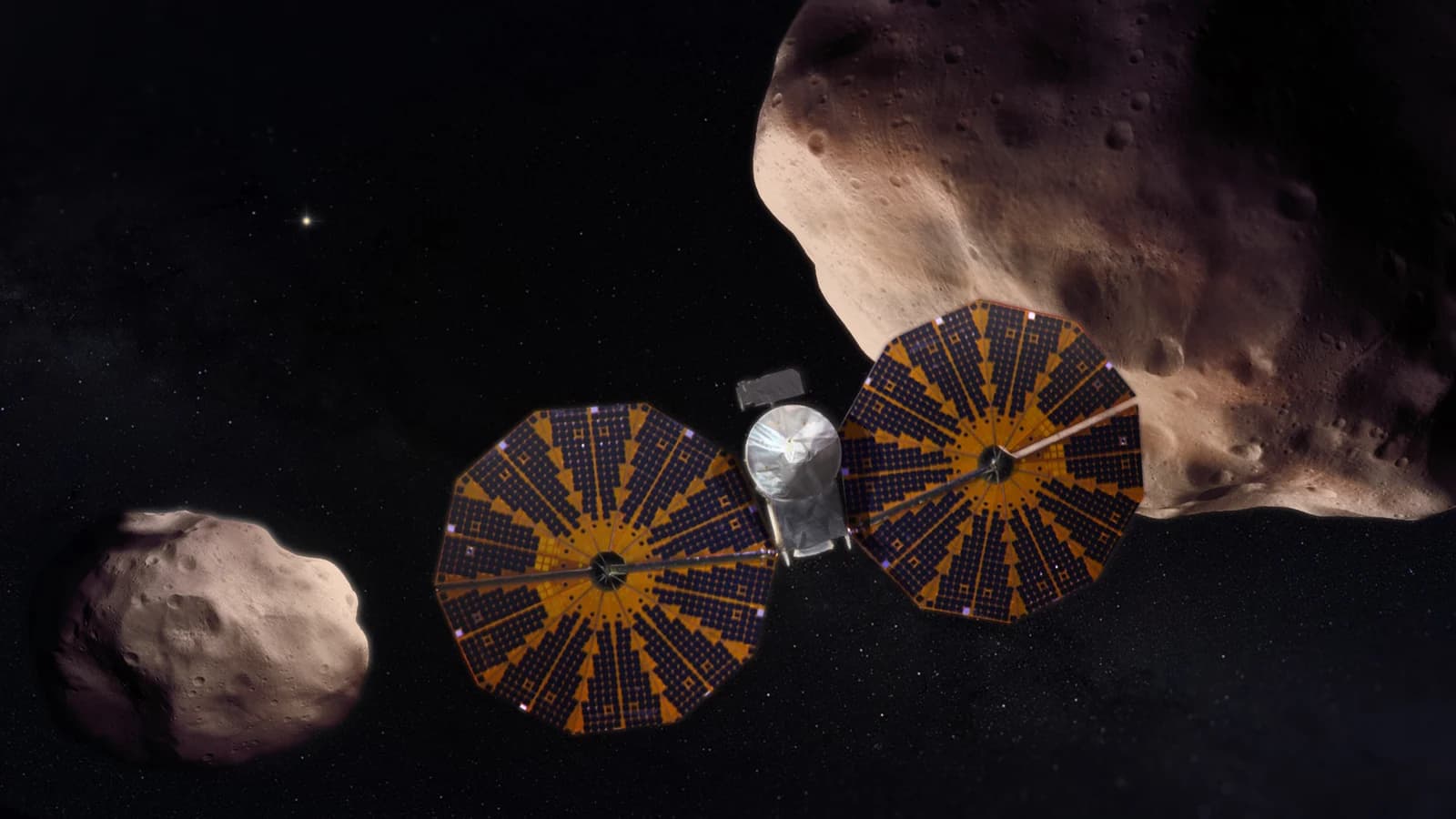
Lucy launched on 16 October 2021. By NASA’s 28 October 2026 update, it had traveled more than 3.5 billion kilometers and become the first spacecraft to enter the Jupiter Trojan region. That is the accumulated path along a complex trajectory. Engineers determine the spacecraft’s position through radio signals and images of stars; there is no visible line in space separating the Trojan population from its surroundings.
The spacecraft is approaching the L4 region ahead of Jupiter in its orbit around the Sun. According to the October update, its instruments and systems are operating as expected. The future targets still look like faint points among the stars. The first close Trojan flyby is scheduled for August 2027, so reaching the region does not mean that detailed pictures of Eurybates or close-range composition measurements have already been obtained.
What Trojans are and how they relate to Jupiter
Jupiter’s Trojan asteroids orbit the Sun with approximately the same orbital period as the planet. Two large groups occupy regions near the L4 and L5 Lagrange points, on average 60 degrees ahead of and behind Jupiter. These are stable regions of the combined gravitational influence of the Sun and planet. Real asteroids are distributed around them on extended orbits rather than gathered at two stationary points.
The regions are extremely sparse, and the Trojans themselves are roughly as far from Jupiter as the planet is from the Sun. Lucy therefore investigates a distinct population of small bodies along Jupiter’s orbit. Reaching them requires different geometry from an expedition to Jupiter’s clouds or nearby moons. Sharing an orbital period explains the group’s association with the giant planet, but does not make these asteroids ordinary Jovian satellites.
How small bodies test the history of large planets
In models of the early Solar System, giant planets changed orbits and scattered surrounding small bodies. Material from different outer regions could have ended up in today’s Trojan groups. This scenario helps explain the diversity of Trojan colors and inferred compositions. The birthplace of each object and the sequence of movements still need to be reconstructed, however: present position alone does not reveal them.
There is another part of the problem: surface differences may reflect not only original material but also heating, irradiation and collisions over billions of years. Lucy should help distinguish these causes. Comparing several objects is more useful than treating one rock as an exact copy of the entire early system. Material can be ancient while a particular surface, crater or fragment is much younger. The phrase “fossils of planet formation” does not imply complete preservation without change.
When Eurybates and the other encounters will occur
Under the plan current on 1 November 2026, Lucy will pass Eurybates and its satellite Queta in August 2027, followed by Polymele and its small satellite in September. The same leading Trojan group contains Leucus, with an encounter expected in April 2028, and Orus, scheduled for November 2028. These events lie ahead: actual close observations depend on carrying out the navigation and instrument program.
Lucy should then return to Earth’s vicinity for a gravity assist in 2030. This will redirect it toward the second group, trailing Jupiter. Its targets there are the binary system Patroclus–Menoetius, with a flyby planned for March 2033. Returning to Earth means a stage of the interplanetary route; the spacecraft will continue toward new asteroids.
Why mission descriptions give different asteroid counts
NASA’s current program lists eleven objects: three in the main belt and eight Trojans, including satellites. This counts bodies to be investigated, not eleven separate orbit insertions. Older materials give a smaller number because the route expanded and moons were discovered around some targets. When comparing lists, it is important to count satellites consistently.
Two main-belt encounters have already taken place. In November 2023, Lucy passed Dinkinesh and discovered Selam, a moon made of two touching lobes. In April 2025, it flew past Donaldjohanson, revealing its elongated shape and narrow neck. These encounters both tested the equipment and produced scientific results in their own right. They belong to the main belt between Mars and Jupiter, so the first Trojan flyby still lies ahead.
Why Lucy flies past rather than staying in orbit
To remain near a small asteroid, a spacecraft must use propulsion to reduce its relative velocity. Repeating capture and departure at many distant bodies would be too costly for this program. Lucy is designed as a scout: one route allows diverse targets to be compared while preserving propellant for corrections. The trade-off for broad coverage is a brief window of the most detailed measurements at each target.
Psyche addresses a different problem: after arrival, it should spend an extended period near one metal-rich asteroid. Lucy will obtain shorter but comparable datasets for several bodies. A carefully prepared command sequence and precise instrument pointing are therefore crucial. Its program includes no lander, material collection or sample return.
What the cameras and spectrometers will reveal
L’LORRI is a sensitive, high-resolution monochrome camera. It will reveal shape, craters, fractures and possible small satellites. L’Ralph combines the MVIC color camera and LEISA infrared spectrometer: images connect terrain units with spectral signatures of rocks, ices and organic compounds. Finding organic material in such an investigation would identify surface chemistry, not living organisms.
L’TES measures thermal emission and helps estimate how rapidly the surface heats and cools. Loose fine dust and large rocks retain heat differently. Reading images, spectra and temperatures together will test the properties of the regolith covering the asteroids. A hue on a color map does not replace a chemical identification: reflected light is affected by both composition and surface conditions.
How to estimate density during a fast flyby
Radio communication will also serve as a scientific instrument. An asteroid’s gravity slightly changes the passing spacecraft’s motion, producing a Doppler shift in its radio signal. Precise tracking can constrain mass. Images from different directions help reconstruct shape and volume; combined with mass, these give bulk density. The method uses a small gravitational deflection rather than scales or a sample from the asteroid’s center.
Density is needed to compare inferred composition and structure. A value can depend both on material and on voids between fragments. It cannot therefore establish immediately that an asteroid is a solid block of a particular rock. Craters and exposed layers will add information about deeper material, but access to the interior will be indirect. Consistency between several measurements should narrow the possible explanations.
What the spring 2026 Trojan observations have already provided
In its 6 August update, NASA described L’LORRI observations of Eurybates, Polymele, Leucus and Orus made in spring 2026. Downlink and processing of those images were completed in July. From great distances, the asteroids do not yet reveal detailed terrain, but they allow future imaging settings to be prepared. This is real observing work before the encounters, with a specific limited purpose.
An observer on Earth views Trojans from nearly the same side as the Sun illuminating them, seeing mainly their dayside. The passing Lucy will see them from a different angle, with part of the surface in shadow. Camera tests help select exposures that preserve faint detail without making images too dark or washed out. The T2CAM terminal tracking cameras will follow target motion and keep the asteroid in the main instruments’ fields of view.
How a solar-powered spacecraft works so far from the Sun
Sunlight in the Trojan region is much weaker than near Earth. Lucy carries two large circular solar arrays, each about 7.3 meters across; deployed, they give the spacecraft a span of nearly 16 meters. The large area supplies power during the distant encounters. The arrays provide electricity to spacecraft systems.
The route uses Earth gravity assists and large loops around the Sun. Travel between the leading and trailing Trojan groups therefore includes a return to the inner Solar System. This scheme connects accessible encounters with one spacecraft. As of November 2026, the distant flybys remain planned, and the science from each will depend on pointing, power supply and instrument health.
Which results could change the picture
The main test is whether the diversity of composition, terrain and physical properties fits a history of capture from different regions. If similar colors conceal different minerals, or different colors arise from surface alteration, models will need refinement. Binary systems, including Patroclus–Menoetius, are particularly interesting: their composition and collision records will help test possible connections with populations farther out.
A striking first image will be only the beginning. Shape must be reconstructed, observations from different instruments connected, and several targets compared with lighting and measurement accuracy accounted for. Lucy will thus test planetary history through surviving small bodies. As of 1 November 2026, a new travel milestone is confirmed, while detailed Trojan reconnaissance lies ahead; its conclusions should not be written in advance as a proven chronology of Jupiter’s migration.
Sources
- NASA — Lucy enters the Trojan region, 28 October 2026
- NASA — current Lucy mission plan and target list
- NASA — science goals: geology, composition and physical properties
- NASA — Trojans, trajectory and the reasons for flybys
- NASA — camera tests ahead of the flybys, August 2026
- NASA — Lucy cameras, spectrometers and radio science experiment
- NASA — Dinkinesh and its contact-binary satellite Selam
- NASA — Donaldjohanson flyby results, April 2025
- NASA — Trojan origins and migration scenarios to be tested
- NASA SVS — original mission illustration and full credit
- NASA — the Psyche mission’s orbital program
Questions and answers
Has Lucy investigated a Trojan asteroid up close yet?
As of 1 November 2026, not yet. The spacecraft has entered the Trojan region and observed targets from afar. The first close flyby, of Eurybates and its satellite Queta, is planned for August 2027.
Are Trojan asteroids moons of Jupiter?
They orbit the Sun with a period close to Jupiter’s in two stable regions near L4 and L5. Hundreds of millions of kilometers separate them from Jupiter itself. They are a distinct orbital population rather than a family of nearby moons.
How many asteroids will Lucy visit?
NASA’s current list contains eleven objects: three in the main belt and eight Trojans, counting satellites. This is a count of bodies; several system components can be studied during one encounter.
Will Lucy return samples or remain near an asteroid?
The program consists of flybys. Cameras and other instruments will collect data during encounters, after which the spacecraft will continue. Landing, orbital operations at each target and sample return are not included.
Will the mission prove that Jupiter migrated?
It should test scenarios of early planetary rearrangement through Trojan compositions and properties. Specific conclusions will emerge after data are compared with models. A scientific hypothesis chosen for testing is not an expedition result known in advance.