A neutron star packs roughly a solar mass into a sphere a few dozen kilometers across. Deep inside, its matter exceeds the density of atomic nuclei, and the composition of its central layers remains under investigation. In a preprint posted on October 30, 2026, astronomers refined the radius of one such object from the pattern of its X-ray pulses. Understanding that result starts with the star’s structure and the sources of its radiation.
- A neutron star has a surface and internal layers. Their properties let scientists test the physics of ultradense matter.
- A pulsar is detected through repeating pulses linked to its rotation. A magnetar stands out for extreme magnetic activity. One object can display both behaviors.
- Radius comes from a model fitted to observations. The October preprint gives 11.35 km for PSR J0437−4715, with an uncertainty of about 0.4 km.
How a star becomes a city-sized object
The collapse of a massive star’s core can leave behind a neutron star. A typical radius is about 10–15 km, with a mass comparable to one or two Suns. Astronomers measure these quantities separately for individual objects. The combination of small radius and enormous mass produces extremely strong gravity. Cosmic neutrinos carry away much of the energy released during the collapse.
Matter’s familiar properties change under this compression. Protons capture electrons, producing neutrons and increasing the neutron fraction. Charged particles remain present in the equilibrium star as well. Its average density is hundreds of quadrillions of kilograms per cubic meter, with still higher density at the center. A diagram of its interior therefore brings together several physical states of matter.
The crust, neutrons, and the uncertain core
A thin atmosphere lies at the surface. Below it are denser layers, including a crust where heavy atomic nuclei form a crystal lattice among electrons. Pressure rises with depth. In the inner crust, some neutrons are no longer confined within individual nuclei, and matter gradually approaches a continuous nuclear medium.
In the standard description of the outer core, neutrons dominate, accompanied by protons, electrons, and muons. Many models predict neutron superfluidity and proton superconductivity. These states affect cooling and the exchange of angular momentum between parts of the star. Researchers test them against the object’s observed properties by comparing physical models.
The deepest region is less well understood. Other particles may appear there, or matter may enter phases in which quarks are no longer confined within individual protons and neutrons. The possibilities depend on how the strong interaction behaves at high density. Astronomers constrain them through stellar masses, sizes, temperatures, and changes in rotation.
What supports the star against further collapse
The star settles into a balance between gravity and the pressure of its matter. Quantum properties and nuclear interactions play essential roles. Physicists describe the relationship among pressure, density, and other quantities with an equation of state. It lets them calculate the radius and maximum mass of a stable neutron star. Different assumptions about matter produce different mass–radius curves.
This is why massive neutron stars matter. If a model permits stability only up to a certain mass and reliable observations reveal a heavier star, the model needs revision. The maximum supported mass is still being refined. It depends on the equation of state and rotation. Accumulation of matter or a merger can upset stability and lead to a black hole.
Why a pulsar flashes
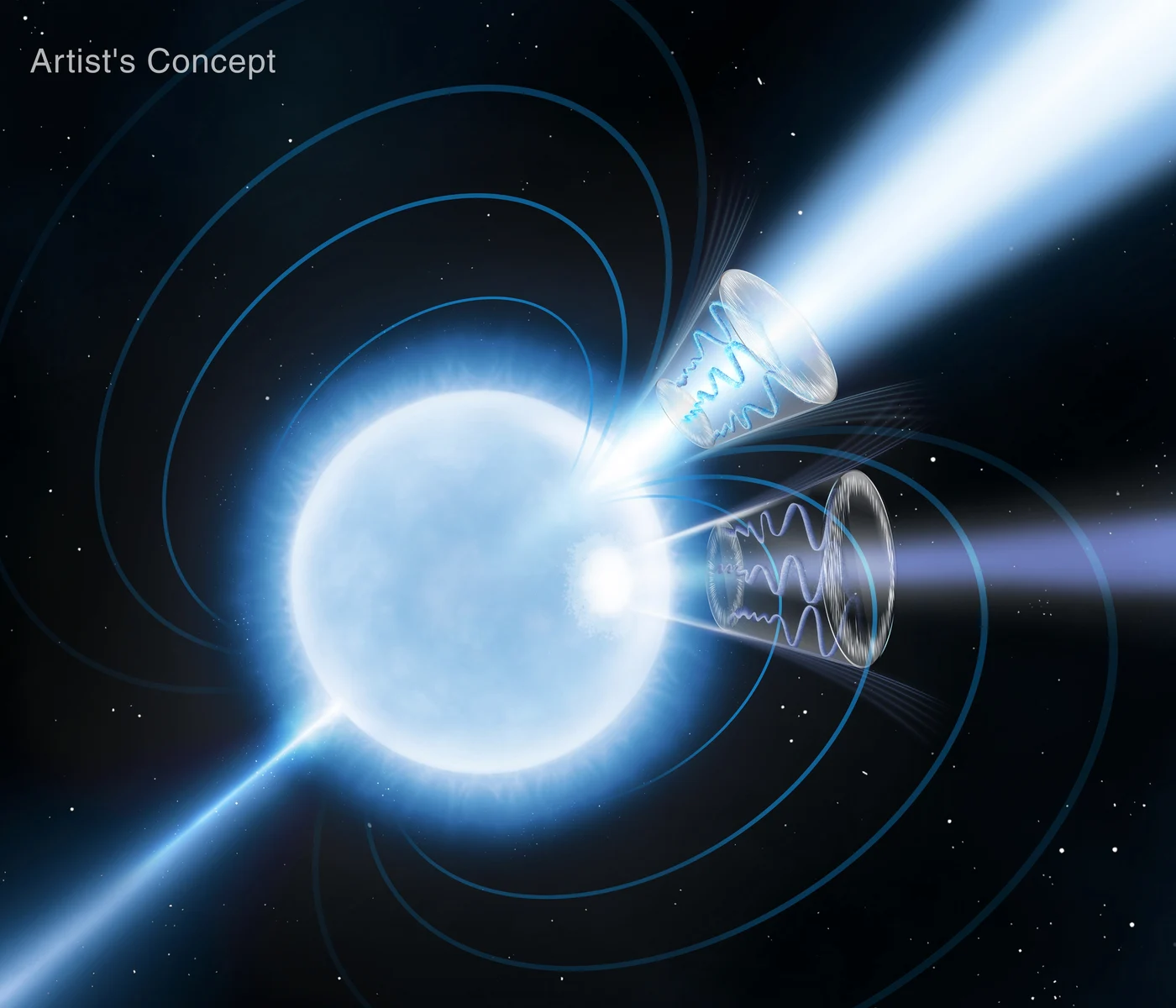
A rotating, magnetized neutron star can accelerate charged particles and produce directed radiation in its magnetosphere. If its magnetic axis is tilted relative to its rotation axis, the beam sweeps around with each turn. An observer receives a pulse when that beam crosses the line of sight. This produces the effect of a rotating lighthouse.
Geometry also shapes the population we detect. Some stars’ beams cross Earth, while others miss it. X-ray emission also comes from hot surface regions viewed at changing angles as the star rotates. Radio, X-ray, and gamma-ray signals can arise in different parts of the same object and have different pulse patterns.
The word “pulsar” describes observed periodic emission. To understand the object, astronomers also determine its energy source, spin, companion, and magnetic properties. Millisecond pulsars are especially useful. Many are old neutron stars that previously received matter and angular momentum from a companion and spun up.
Rotation, infalling gas, and magnetic fields
In a rotation-powered pulsar, the energy reservoir gradually shrinks. Radiation and particles carry away energy and angular momentum, so the star generally slows down. By measuring the pulse period and its evolution, researchers estimate how it spends that reservoir. Sudden changes in frequency, called glitches, sometimes interrupt the gradual spin-down and help probe how internal layers are coupled.
In a close binary, accretion can supply the power. Gas from a companion enters the neutron star’s gravitational field, heats up, and is channeled toward the surface by magnetic fields. The hot regions produce bright X-rays. “X-ray pulsar” therefore specifies an observing band, while the energy source must be established for the individual system.
For a magnetar, the magnetic energy reservoir is especially important. Rearrangement of its intense field and stresses in the crust are linked to X-ray and gamma-ray outbursts. Some magnetars also produce regular radio pulses, so pulsar behavior and magnetic activity can coexist. Their connection with fast radio bursts is a separate research problem, requiring an explanation for each brief pulse and its energy.
How astronomers measure an unresolved star
Even a nearby pulsar is too small on the sky for an ordinary image to resolve its surface in detail. In a binary, masses can be estimated from the stars’ motion and delays in the arrival of radio pulses. In particular, a signal passing through the companion’s gravitational field experiences an extra delay. Combining several orbital parameters constrains the component masses.
One method for finding the radius uses the X-ray pulse profile: brightness as a function of rotational phase. Gravity bends light paths, bringing some emission from the far side of the surface into view. The amount of bending depends on the mass-to-radius ratio. It changes the pulse shape, which can be compared with a calculated profile.
NICER, an instrument on the International Space Station, records X-ray photons and their arrival times. Analysis combines many stellar rotations and accounts for the background, hot-region shapes, atmosphere, and viewing orientation. Combining telescopes helps distinguish these effects. The resulting radius comes with an uncertainty range and the conditions of the adopted model.
What the 2026 studies added
On October 30, Pierre Stammler and colleagues posted a preprint analyzing PSR J0437−4715. They combined NICER, XMM-Newton, NuSTAR, and Hubble ultraviolet data with radio-timing constraints. Their preferred model yielded a mass of 1.377 solar masses and an equatorial radius of 11.35 km. The reported 68% credible interval for the radius is 10.96–11.75 km.
As of November 5, the work is a preprint submitted to a journal. The result applies to this star and its adopted emission model. Comparing it with measurements of other pulsars narrows the allowed equations of state. Establishing the core’s composition requires testing which models of matter fit the combined evidence.
NASA presented another result on August 5. Using March–April 2025 observations of magnetar 1E 1547.0−5408, researchers compared radio and X-ray polarization. A model including vacuum birefringence explained the high polarization. Quantum electrodynamics predicts this effect of a strong field on light propagation. The result supports the effect through an interpretation that depends on the source model and geometry.
What else the pulses can reveal
An equation of state must simultaneously explain the masses, radii, stability, and cooling of different stars. Thermal emission provides information about surface temperature, while gravitational waves from mergers constrain how easily the stars themselves deform. Each method responds to different properties and has its own uncertainties. Testing them together helps distinguish models of the interior.
An amateur telescope will generally reveal a surrounding nebula much more easily than the compact object itself. Studying the neutron star requires time-resolved measurements in several bands. An image locates the source, while its pulse sequence reveals the rotation. Changes in that sequence gradually help astronomers refine their picture of events deep beneath the surface.
Sources
- NASA: stellar types and neutron-star remnants
- A. Y. Potekhin: neutron-star physics, 2018 review
- NASA: measuring neutron-star squeezability
- ESA: temperature, dense matter, and the equation of state
- NASA Fermi: pulsars and emission geometry
- NASA: neutron stars and the NICER mission
- Chandra: neutron stars and accretion-powered pulsars
- Chandra: a magnetar with pulsar properties
- Özel and Freire: masses, radii, and the equation of state
- NICER: how light bending shapes a pulse
- Stammler et al.: PSR J0437−4715 analysis, October 30, 2026 preprint
- NASA IXPE: polarization of magnetar 1E 1547.0−5408
- NICER: spin glitches and coupling of internal layers
Image
Questions and answers
Is a neutron star made entirely of neutrons?
Models also include nuclei, protons, electrons, and other particles. Their proportions change with depth. The composition of the central region remains under investigation.
How does a pulsar differ from a magnetar?
A pulsar is identified by periodic emission linked to rotation. A magnetar is distinguished by an intense magnetic field and the release of its energy. One star can display both properties.
How large is a neutron star?
A common guide is a radius of 10–15 km, or a diameter of 20–30 km. Size depends on mass and the properties of matter. It is inferred from observations for an individual object.
Will the Sun become a neutron star?
Current evolutionary models predict that the Sun will shed its outer layers after its red-giant phase and leave a white dwarf. Producing a neutron star requires a different path of core evolution.
Have scientists found quarks inside a neutron star?
Quark matter is considered in models of central layers. Mass and radius measurements constrain the possibilities, while identifying a particular composition depends on agreement among several methods.