A wormhole offers one of science fiction’s most tempting routes: a short passage between distant regions of space. Physics first has to establish what geometry would allow such a route and what could support it. A paper published on October 26, 2026 added a calculation of particle motion near a hypothetical throat. Astronomers have yet to detect a wormhole itself.
- A wormhole is a hypothetical connection between regions of spacetime.
- Travel would require a traversable throat, stability, and survivable conditions along the entire route.
- The October 2026 paper examines a specified model and contains no astronomical observation data.
What a wormhole is
The Russian terms krotovaya nora and chervotochina both mean wormhole. Its geometry connects regions of spacetime through a throat. The two mouths could be far apart along an ordinary external route yet connected by a shorter internal path.
General relativity connects geometry with the distribution of energy, momentum, and pressure. One approach is to specify a throat’s shape and calculate what properties its supporting matter would need. Another is to choose fields and matter and check whether the desired solution emerges. A successful calculation establishes consistency between the assumptions and the equations. A cosmic object also needs a physical way to form and persist.
Why diagrams use a folded sheet
In the familiar diagram, two points lie on a sheet of paper. Folding the sheet brings them together, with a bridge between them. The illustration compares the lengths of two routes. It depicts a two-dimensional slice of space embedded in an extra dimension for clarity. The drawing does not establish that there is an external space beside Earth that a spacecraft could simply enter.
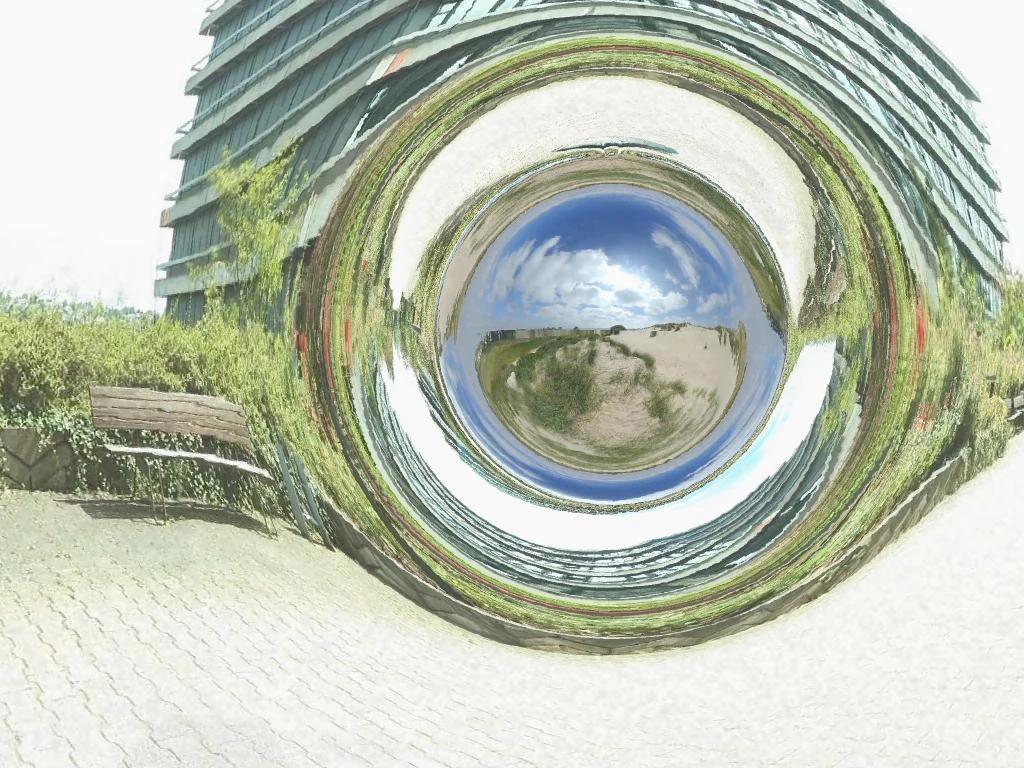
In three spatial dimensions, the mouth of a spherically symmetric model is spherical. What a camera sees depends on the paths of light near and through the throat. Rays can bring distorted, repeated images of the surrounding sky and the far side. Tracing rays backward from a camera is therefore more informative than guessing the view from a drawing of a tube.
How a wormhole differs from a black hole
A black hole’s defining boundary is its event horizon. Light from inside it cannot reach a distant external observer. A traversable wormhole must allow a signal or traveler to cross the throat and emerge on the other side. In simple classical models, that requires a path without an event horizon. Two compact objects can bend light in similar ways while having very different internal geometries.
The Einstein–Rosen bridge is associated with the geometry of a nonrotating black hole. Its idealized description contains two exterior regions, but there is no traversable route between them for a light signal or spacecraft. A usable passage requires a different geometry.
What a safe passage would require
In a model, traversability means a traveler can get from one mouth to the other in a finite time. A crewed journey adds requirements for throat size, tolerable acceleration, and tidal forces. Tidal forces arise when gravity differs appreciably between a person’s head and feet or different parts of a spacecraft. A wide mouth tells us little about these conditions without a calculation of the entire route.
The throat’s response to disturbances must also be checked. Incoming matter, radiation, and changes in the supporting fields can alter the geometry. A static solution describes a state, while its stability is a separate problem.
Why calculations call for exotic energy
Keeping a classical throat open is difficult because of how gravity affects converging light rays. Morris–Thorne models require unusual relationships between energy density and radial tension. These violate energy conditions satisfied by familiar classical forms of matter. Here, exotic matter is a name for those properties in the equations. A way to obtain an appropriate source still has to be justified.
Quantum fields allow situations with negative energy density relative to a chosen vacuum state. Its magnitude, duration, and spatial distribution face linked constraints. Ford and Roman applied such constraints to static wormholes and found severe difficulties for macroscopic throats. The result depends on the field considered and the approximation’s validity. A design cannot simply assume any desired amount of negative energy.
Are there models using known quantum fields?
Maldacena, Milekhin, and Popov described a traversable wormhole in four dimensions with an electromagnetic field and charged massless fermions. The particles’ quantum contribution supplies Casimir-like negative energy that supports the solution. This illustrates how a specific physical model can give substance to the term exotic. The energy source and geometry can then be considered together.
The wormhole in that construction is long and preserves causality in the surrounding space. Traversability alone does not guarantee a time advantage over an external route. Each construction requires comparisons of lengths and travel times, together with checks on size and stability.
What the new October 2026 paper calculated
On October 26, The European Physical Journal C published a paper by Zhao and colleagues on a test particle near a symmetric throat. The geometry is specified in advance, and an external potential resembling a spring’s confines the particle. The authors studied motion on one side of the wormhole. At certain energies, chaotic trajectories coexisted with regular ones. Chaos here means that initially nearby trajectories rapidly diverge.
Comparison with black hole calculations revealed differences within the chosen setup. The authors propose developing them as a possible diagnostic. The paper does not yet calculate a telescope image or test passage through the throat. Those steps need further modeling. The publication contains no experimental data.
Why Interstellar’s wormhole looks spherical
For the film, the visual effects team and Kip Thorne calculated light paths in a chosen geometry. The result shows a distorted view of another region of sky within a spherical mouth, with lensing around it. The authors later described the method in a scientific paper that allows the throat’s length and image distortion to be varied. The cinematic appearance is grounded in ray calculations. What matter could support such a passage remains a separate physical question.
What happened on the quantum computer
In 2022, Jafferis and colleagues carried out a quantum information transfer protocol on the Sycamore processor. For a specially chosen small quantum system, they used a description connected to traversable wormhole dynamics. Caltech explicitly stated that the experiment created no rupture in physical spacetime. Information moved between parts of a quantum system in the laboratory.
How fully the small model reproduces the intended gravitational dynamics became a separate debate. In 2023, Kobrin, Schuster, and Yao pointed to limitations in its behavior and the result’s dependence on model training. This shows why the phrase wormhole dynamics must be read alongside a description of the measured system. A quantum protocol tests particular model properties, and its interpretation requires scrutiny of its own.
What signatures could be sought in the sky
One approach is gravitational lensing. As light passes a compact object, its direction changes and a background star’s apparent brightness follows a characteristic pattern over time. In Abe’s calculation for an Ellis wormhole, the light curve differs from that of an ordinary point mass. Comparing these predictions with surveys of Milky Way stars can test particular throat sizes and object populations. The outcome depends on the chosen geometry and assumed number of wormholes.
A test can constrain one class of models without covering every mathematically allowed possibility. A positive conclusion would require showing that a particular wormhole explains the observed pattern better than an ordinary lens, multiple light sources, or measurement effects. No object has yet been confirmed with such a body of evidence.
What gravitational waves could add
Gravitational waves from compact objects offer another way to test their internal geometry. Calculations by Cardoso, Franzin, and Pani showed that the early ringdown can look similar for a black hole and a very compact object with a different interior. Differences may emerge later, including as additional delayed responses. Interpreting such a response requires checks of the noise, the initial model, and other possible explanations. Similar ringdown alone does not determine a throat’s structure.
Could a wormhole allow time travel?
In a hypothetical construction with two traversable mouths, their clocks could be offset, for example by different motion. Combining the route through the throat with an external route could then create a closed timelike path. This returns the problem to causality and whether physical laws allow such a configuration to be created and maintained. Describing it with equations does not establish whether it would survive quantum effects and disturbances.
A short spatial route and a route into the past require different conditions. Each new paper needs to be read for what it calculates: throat shape, energy source, stability, particle motion, or observable light. Its result concerns that particular step, while the existence of a suitable passage in space remains an open question.
Sources
- NASA: questions about wormholes and time travel
- James et al.: Visualizing Interstellar’s Wormhole
- Morris, Thorne, and Yurtsever: wormholes and causality
- Ford and Roman: quantum constraints on wormhole geometries
- Maldacena, Milekhin, and Popov: a traversable model in four dimensions
- Zhao et al.: chaotic dynamics near a wormhole throat, October 2026
- Abe: calculations of microlensing by an Ellis wormhole
- Cardoso, Franzin, and Pani: gravitational ringdown and the horizon
- Jafferis et al.: model dynamics on a quantum processor
- Caltech: what the 2022 experiment measured
- Kobrin, Schuster, and Yao: a critical analysis of the quantum model
- NASA: observational signatures of black holes
Questions and answers
Do wormholes really exist?
As of November 2026, no wormhole in space has been confirmed. Physicists study mathematical models and ways to distinguish their observational signatures.
Could you travel through an ordinary black hole?
Observed black holes have event horizons. The Einstein–Rosen bridge in the idealized geometry of a nonrotating black hole does not provide a traversable route between its exterior regions.
Would a wormhole break the speed of light?
A spacecraft could follow an internal route at a local speed below that of light. Any advantage would come from the route’s length. It depends on the geometry and is not present in every traversable model.
Was a new way to detect a wormhole found in 2026?
The October paper proposes investigating differences in test particle motion within specified models. It does not yet provide a ready telescope test or an observation of a real object.
Is the image in Interstellar based on science?
The team calculated light paths in a chosen geometry and described the method in a scientific paper. That produces a plausible view of the model without proving that it exists in nature.