Libra: weekly horoscope
—
Allow yourself to make a good-enough choice without endless comparisons. Set secondary options aside for a while and listen to what matters most to you now.
Plans and focus
Compare two realistic choices against three criteria that matter to you. Write down what you do not yet know instead of trying to predict everything.
Communication
Discuss a small shared arrangement: what works for each person, and which option you can try without unnecessary strain.
This week's activity
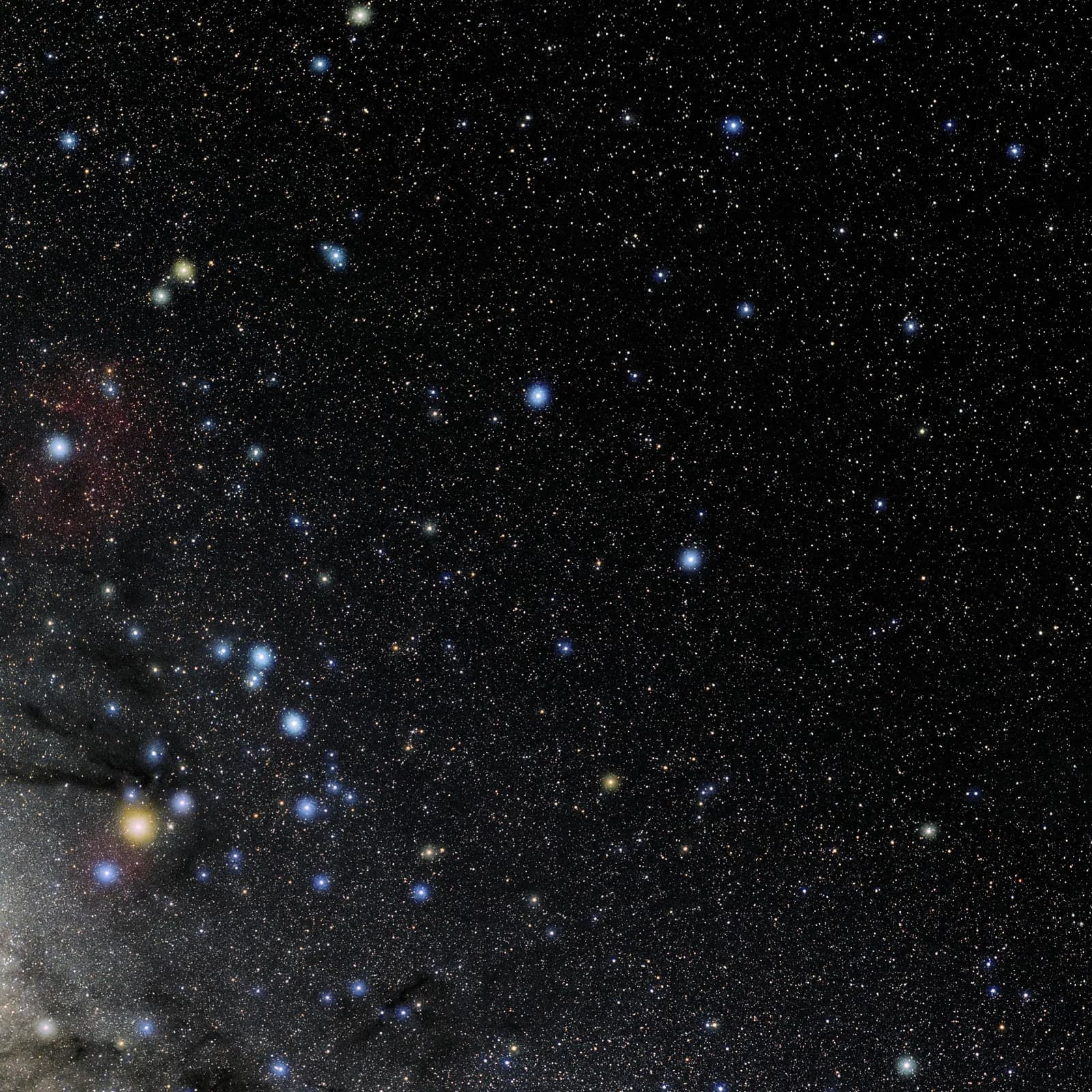
Find Libra's two guide stars on the map. Then open a photograph and see what you remember without labels.
The weekly horoscope is original entertainment and a prompt for reflection, not a scientific prediction or a description of your personality. Its suggestions are not based on the influence of stars and do not replace your own judgment.
Constellation Libra.
A sign is a conventional zodiac sector; a constellation is a region of the starry sky. The sign dates above do not describe when the Sun is within the constellation's boundaries.
- α Librae
- Zubenelgenubi
- β Librae
- Zubeneschamali
- Beyond the Milky Way
- Arp 261 — interacting galaxy pair
Libra's figure on the map
The name Libra means scales. In this region, the ecliptic passes among relatively faint stars. Begin with α and β Librae, Zubenelgenubi and Zubeneschamali, labeled on the map.
First locate Libra relative to neighboring Virgo and Scorpius, then zoom into its own pattern. Moving from a wide field to a few stars is usually easier than searching for isolated faint points without their surroundings.
What lies behind the quiet pattern
In the direction of Libra lies Arp 261, a pair of interacting galaxies about 70 million light-years from Earth. Their unusual appearance reflects a close gravitational encounter and disturbances in their gas.
During such interactions, individual stars rarely collide directly, but gas clouds can compress and give rise to new stars. Here, the constellation serves as an address; observations of the distant pair tell the physical story.
Keeping Libra’s sparse figure in view
A route from surroundings to outline works well for Libra. In a wide field, mark the Virgo side and the Scorpius side, then find the labelled Alpha and Beta Librae. Do not mentally shorten the gap between them just to resemble a pair of weighing pans. Stellar positions establish the identification; the familiar object aids memory without requiring a perfectly symmetrical sky pattern.
On a phone, retain both main stars and part of a neighbouring constellation. Zooming to a single point can make Libra harder to recognise even when its label is visible. Find the two references in an unlined photograph first, then turn on the diagram to check the remaining segments. Alternating the views teaches the actual pattern rather than only its graphical aid.
Why the Arp 261 image contains coloured trails
ESO’s published Arp 261 image also contains trails from two asteroids. These nearby objects moved between exposures through different colour filters. Their tracks therefore became multicoloured while distant stars and galaxies remained in nearly the same positions. A feature resembling a strange ray beside a galaxy can belong to an entirely different distance and motion.
This illustrates why processing notes matter. A coloured streak does not always mean coloured gas or evidence of a cosmic disaster. First check which exposures were combined and which features are separately identified. An image toward Libra can include Solar System bodies alongside remote galaxies; accidental overlap does not establish a physical connection.
Three questions for reading a Libra photograph
First ask what lies in the foreground. Separate Milky Way stars from Arp 261 itself and from moving trails. You do not initially need every distance; correctly classifying the objects is enough. Labelling a personal sketch makes the multiple layers of space behind the simple address “in Libra” easier to appreciate.
Second, identify features associated with the interacting galaxies. Compare their overall form, stretched faint areas, and compact bright regions without assigning every detail a cause by appearance alone. Check where the caption reports an observed structure and where it offers a physical explanation. This is more informative than seeking a resemblance to a ready-made zodiac symbol.
Third, decide what your own observation might reveal. Libra’s reference stars and the subtle details of a professional image demand different capabilities. Set two separate goals: recognise the sky pattern and study Arp 261’s image at home. Completing the first does not require detecting the second. A faint constellation can begin an investigation without promising an unaided view of a complex galactic encounter.
What the star pattern looks like
Questions about the sign and constellation
Which stars help me find Libra?
The map labels α Librae, Zubenelgenubi, and β Librae, Zubeneschamali. Compare their positions with neighboring constellations; visibility above the horizon depends on your location and the time.
Is Arp 261 part of Libra's star figure?
No. These are distant galaxies in the same direction. They are not associated with the stars connected by lines to form Libra on the map.
Sources and photograph
The sources below support the astronomical information. The horoscope is original COSMO360 entertainment content; it is not a conclusion drawn by NASA, the IAU or observatories.
- IAU / Sky & Telescope: Libra constellation chart
- ESO: the unusual galaxy pair Arp 261
- NASA Space Place: constellations, astronomy and astrology
- NASA Night Sky Network: zodiac signs and constellations
- Original photograph — E. Slawik/NOIRLab/NSF/AURA/M. Zamani
- CC BY 4.0 terms
- Chart: HYG 4.1 catalog, J2000 coordinates