Scorpio: weekly horoscope
—
Explore one question more deeply than usual, but do not search for hidden meaning in every detail. A useful pause can help separate observation from guesswork.
Plans and focus
Choose a topic and state the specific answer you need. Separate what can be checked from your own assumptions.
Communication
If a conversation seems ambiguous, gently ask for clarification. A simple explanation is often more useful than a complicated guess.
This week's activity
Compare Antares's color with neighboring stars in a photograph and locate M4 on the map.
The weekly horoscope is original entertainment and a prompt for reflection, not a scientific prediction or a description of your personality. Its suggestions are not based on the influence of stars and do not replace your own judgment.
Constellation Scorpio.
A sign is a conventional zodiac sector; a constellation is a region of the starry sky. The sign dates above do not describe when the Sun is within the constellation's boundaries.
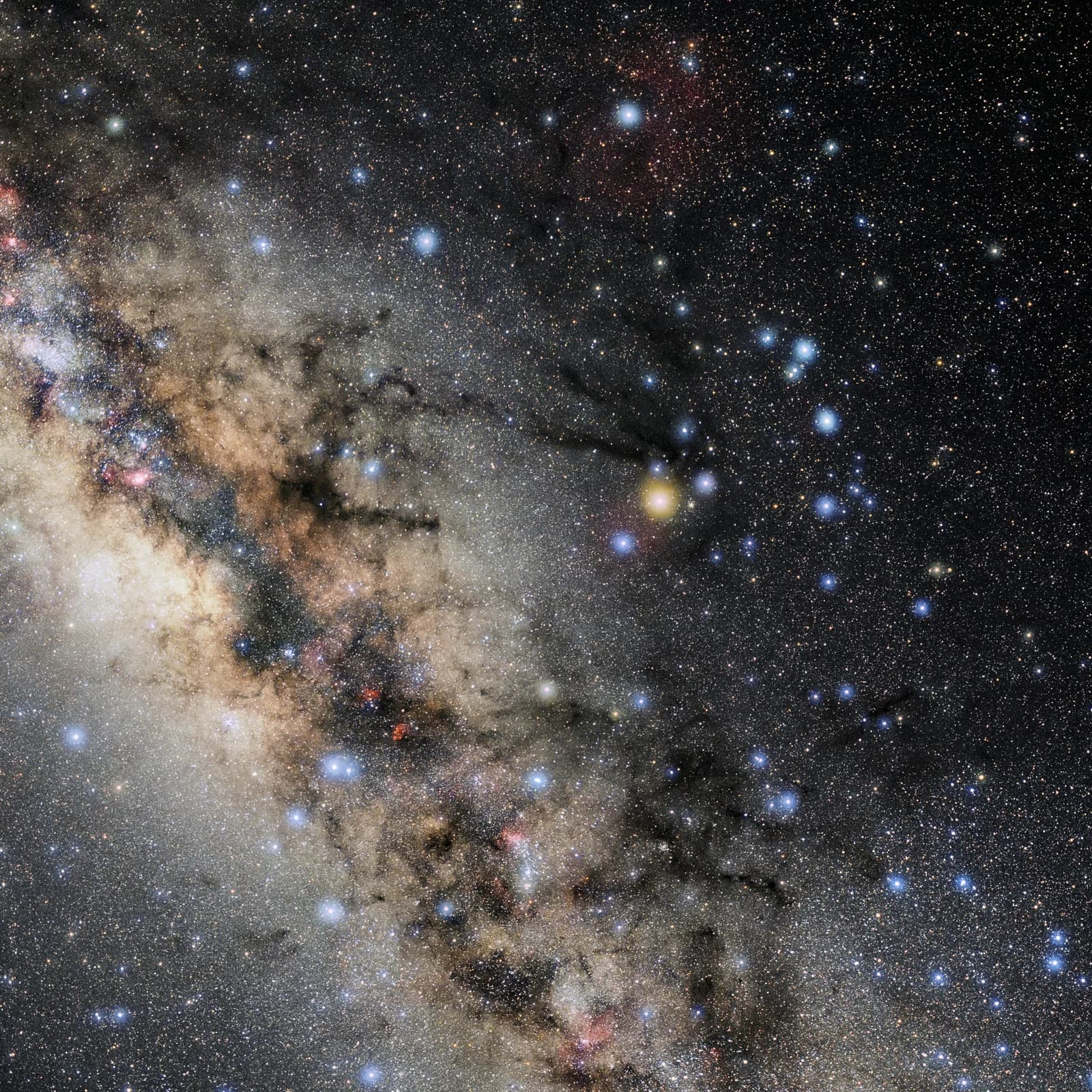
- Main star
- Antares — red supergiant
- Nearby in the sky
- M4 — globular cluster
- Distance to M4
- About 5,500 light-years
Scorpius and the celestial fishhook
Antares is often called the heart of Scorpius. Its reddish light stands out among neighboring stars. A long curve extends from the central figure, ending in a sting.
In some Polynesian traditions, the same pattern was recognized as Māui's fishhook. Such stories show how differently people have understood the same sky: a familiar European name does not erase other cultural images.
Where to look near Antares
Antares makes a useful starting point for finding M4. This globular cluster, about 5,500 light-years away, is a dense group of stars that looks different from the imagined lines of Scorpius itself.
Before planning an observation, check this region's altitude above the horizon. At northern latitudes, the low position of the tail limits the view; a map set to your time and location is more useful than a blanket promise that it is 'visible tonight'.
Planning a view of the long tail
Scorpius extends far from Antares, so seeing the bright central star does not guarantee a view of the sting. Compare the whole outline with the local horizon. If the tail remains below it, changing magnification or screen brightness cannot help. Study the accessible part and establish whether another time or a location farther south is needed.
Account separately for real obstacles: a chart cannot know the building directly in front of you. Locate an open view of the required horizon sector during daylight. In the evening, begin at Antares and check each available bend. This preserves the connection with the full figure without mistaking partial visibility for a reversed or incorrect map.
How old stellar remnants help researchers study M4
M4 research includes extremely faint white dwarfs as well as conspicuous bright stars. These compact remnants gradually cool, providing information about the stellar population’s age. Such work requires extended observations and comparison with models; a cluster’s age cannot be judged from how “old” a colour photograph appears.
M4’s proximity to Antares is useful for locating it, but does not make the red supergiant a cluster member. Direction provides a sky route; physical measurements establish membership. Keep these levels distinct: one star guides the eye to a target, the target has its own stellar population, and detailed photography reveals far more than a first eyepiece view.
What to record after observing Antares
Describe the colour in your own words before viewing a processed image. Then compare Antares with nearby stars you have confidently identified. Do not estimate an exact temperature from one impression: photographic colours depend on processing, and visual perception depends on conditions. The exercise is about noticing a consistent difference rather than repeating a memorised colour name.
Sketch the central region, using different symbols for Antares and the direction toward M4. Add only the tail segments you confirmed. You can draw the atlas continuation as a dotted line, provided it is labelled as such. The record then separates observation from reference material even when half the striking celestial hook is inaccessible from your latitude.
Choose one testable task for the next attempt: follow another bend, refine M4’s location, or compare Antares’ colour again. Avoid changing time, location, and instrument simultaneously if you want to understand a difference. Even a bright constellation becomes familiar gradually; repeating a small route builds confidence more effectively than one long tour of every chart label.
What the star pattern looks like
Questions about the sign and constellation
Why does Antares look reddish?
It is a red supergiant. Its noticeable color reflects the star's physical properties, not the symbolic meaning of the Scorpio zodiac sign.
Why can I see all of Scorpius on the map but not in the sky?
The atlas shows the celestial region without your local obstacles or horizon. In reality, part of the figure may be below the horizon or too low above it. Latitude, time and an unobstructed view matter.
Sources and photograph
The sources below support the astronomical information. The horoscope is original COSMO360 entertainment content; it is not a conclusion drawn by NASA, the IAU or observatories.
- NASA Night Sky Notes: Antares, Scorpius and Māui's fishhook
- NASA / Hubble: the globular cluster M4
- IAU / Sky & Telescope: constellation chart for Scorpio
- NASA Space Place: constellations, astronomy and astrology
- NASA Night Sky Network: zodiac signs and constellations
- Original photograph — E. Slawik/NOIRLab/NSF/AURA/M. Zamani
- CC BY 4.0 terms
- Chart: HYG 4.1 catalog, J2000 coordinates