Virgo: weekly horoscope
—
Begin with clarity: put precise names to the things that have been circling in your mind. One clear next step is more useful than a long list without priorities.
Plans and focus
Take one confusing note or plan and separate facts, questions and immediate actions. Do not try to redo everything at once.
Communication
Clarify expectations in simple terms: what exactly is needed, by when, and where you can help.
This week's activity
Compare Spica on the map with a photograph of M87. Label the star and the galaxy, and explain why both appear in the same constellation.
The weekly horoscope is original entertainment and a prompt for reflection, not a scientific prediction or a description of your personality. Its suggestions are not based on the influence of stars and do not replace your own judgment.
Constellation Virgo.
A sign is a conventional zodiac sector; a constellation is a region of the starry sky. The sign dates above do not describe when the Sun is within the constellation's boundaries.
- Guide star
- Spica — α Virginis
- Another guide star
- Vindemiatrix — ε Virginis
- Distant object
- M87 — elliptical galaxy
Do not try to take in all of Virgo at once
Virgo has a sprawling figure. Begin by marking Spica on the map, then move to the neighboring chains and Vindemiatrix. Once you find the reference points, the long pattern no longer looks like a random scattering.
In a modern atlas, a constellation has boundaries containing both stars and galaxies. Calling something 'a galaxy in Virgo' describes the direction in which we look, rather than making it part of the star figure.
M87 and the depth behind a familiar name
M87 is a large elliptical galaxy in the Virgo Cluster. It has a supermassive black hole at its center, and observations reveal a jet of material emerging from the central region.
A star chart and a Hubble image serve different purposes: one helps locate a direction, while the other reveals the structure of a distant object. When comparing them, ask yourself what scale of space you are looking at.
From Spica to M87: changing chart scale
Spica locates the constellation but does not replace a detailed galaxy chart. Move from the wide view toward a selected area through a sequence of confirmed stars. Keep at least one familiar reference at every step. Jumping directly from bright Spica to a close-up of M87 breaks the connection between fields, leaving the illustration unable to guide a telescope.
Notice the different labels: Alpha identifies a star in a letter-based designation system, while M87 is a Messier catalogue object. They are not two ways of numbering identical points. Add a small legend with separate symbols for stars and galaxies. Virgo’s crowded map then becomes a set of specific targets rather than a field of equivalent bright circles.
Why M87 does not resemble a black-hole image
A wide image of M87 is dominated by the combined light of countless unresolved stars. Its central black hole occupies a radically different angular scale. Do not expect to find the familiar EHT ring in every galaxy photograph: the observations use different instruments, wavelengths, and methods. Images with the same target name can cover areas differing by many orders of magnitude.
Detailed Hubble frames reveal a jet from M87’s central region, associated with processes around its supermassive black hole. It is not a flashlight beam extending across Virgo’s stellar figure. Compare the central jet with the galaxy’s size and read the image scale. Its displayed length says nothing about physical dimensions without that information.
Reading a rich Virgo field photograph
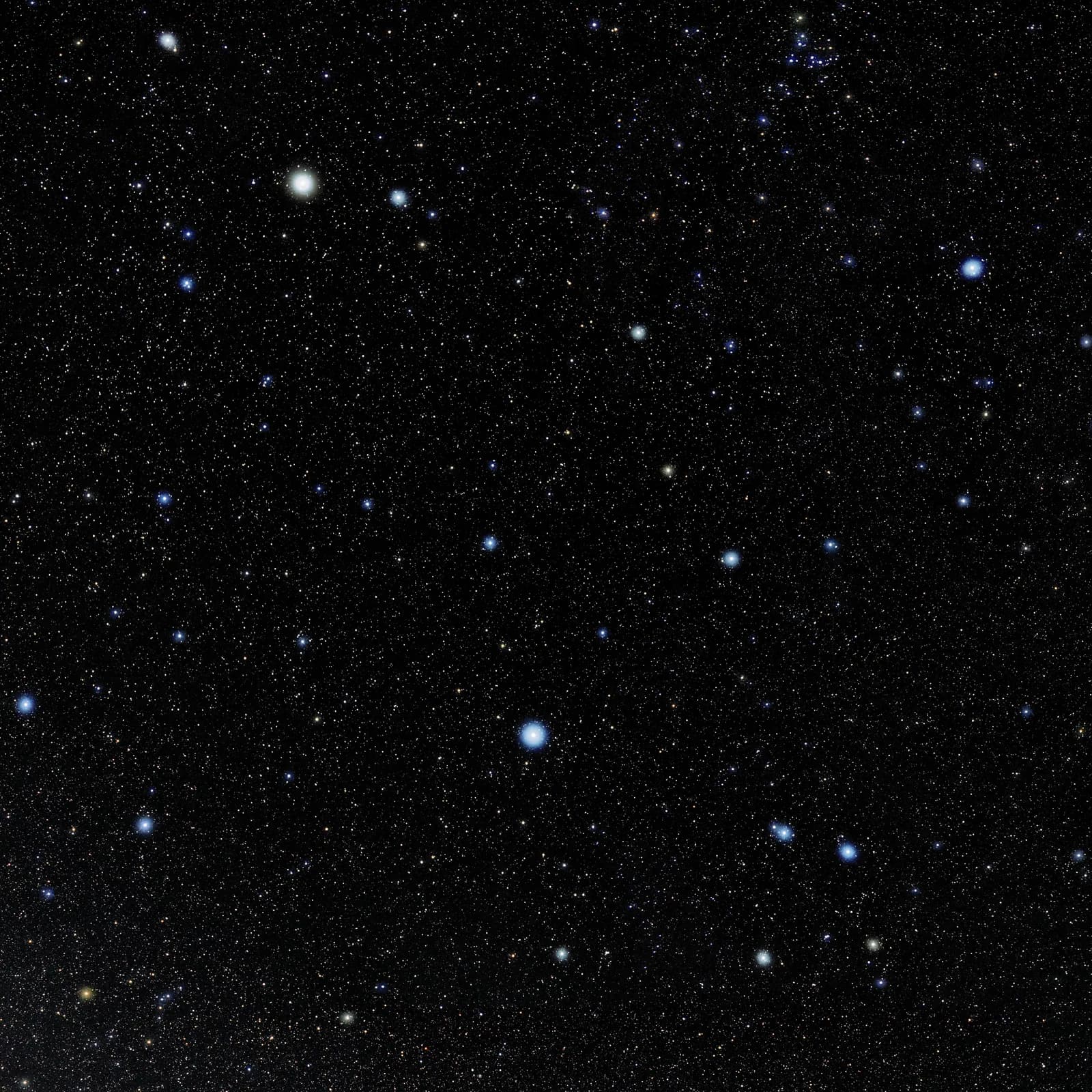
Foreground stars in one frame may look brighter than distant galaxies. This does not make each star larger or more powerful than an entire stellar system. The image is a projection combining very different distances. Begin with just three marked objects and identify their types from the captions, then return to the wide field and notice what the close-up left out.
M87 has its own system of globular clusters, which can appear as tiny points in an image. They should not automatically be treated as stars in Virgo’s outline. A deep-sky frame contains nested structure: a constellation as a direction, a galaxy along that direction, and clusters around the galaxy. Following that sequence helps place each name correctly.
Separate personal observations from professional results in your notes. A backyard observation may record the galaxy’s faint glow, while jet properties or the central shadow belong in a reference column. This keeps an authentic sky view from seeming inadequate beside a space photograph, and connects scientific information to the method that produced it.
What the star pattern looks like
Questions about the sign and constellation
Are the constellation Virgo and the Virgo Cluster the same thing?
No. A constellation is a region of the sky, while the Virgo Cluster is a physical group of galaxies in that direction. The stars that make up the constellation pattern are much closer.
Can an amateur telescope show M87's black hole?
No. A telescope may help detect light from the galaxy itself, but imaging its central black hole requires entirely different instruments and methods.
Sources and photograph
The sources below support the astronomical information. The horoscope is original COSMO360 entertainment content; it is not a conclusion drawn by NASA, the IAU or observatories.
- IAU / Sky & Telescope: constellation chart for Virgo
- NASA / Hubble: the galaxy M87
- NASA Night Sky Notes: what observers can see in M87
- IAU: constellations, their names and official boundaries
- NASA Space Place: constellations, astronomy and astrology
- NASA Night Sky Network: zodiac signs and constellations
- Original photograph — E. Slawik/NOIRLab/NSF/AURA/M. Zamani
- CC BY 4.0 terms
- Chart: HYG 4.1 catalog, J2000 coordinates