Leo: weekly horoscope
—
Show what you have already done instead of waiting for a perfect moment. Try sharing a small result and explaining why it matters to you.
Plans and focus
Choose one finished piece of work or a hobby project. Prepare a short explanation of what you did and what you like about it.
Communication
Ask for specific feedback and thank the person for it. In your own response, notice the details rather than offering only an overall judgment.
This week's activity
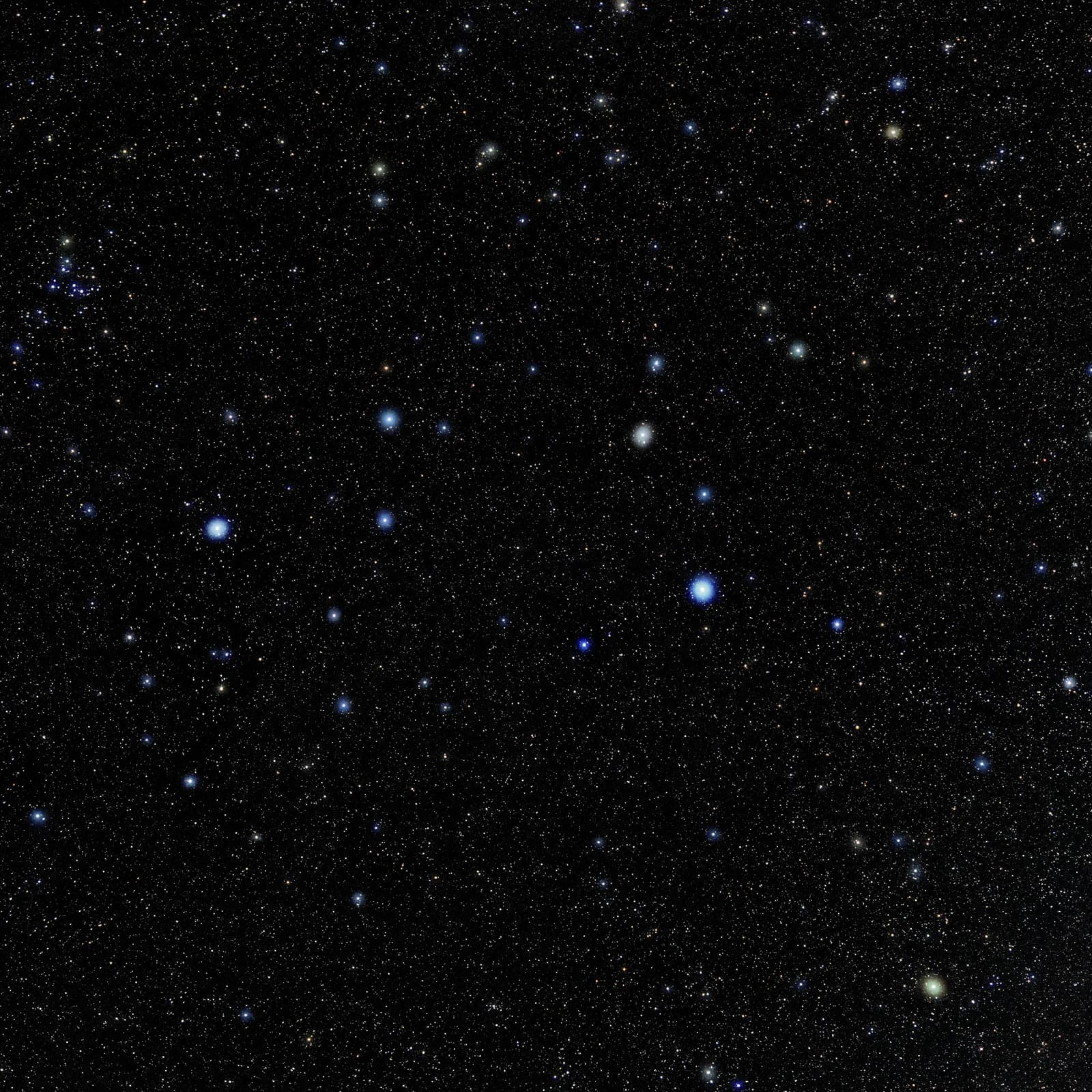
Draw Leo's Sickle and triangle from memory, then compare your sketch with the map.
The weekly horoscope is original entertainment and a prompt for reflection, not a scientific prediction or a description of your personality. Its suggestions are not based on the influence of stars and do not replace your own judgment.
Constellation Leo.
A sign is a conventional zodiac sector; a constellation is a region of the starry sky. The sign dates above do not describe when the Sun is within the constellation's boundaries.
- Main guide star
- Regulus — α Leonis
- Recognizable pattern
- The Sickle asterism
- Leo Triplet
- The galaxies M65, M66 and NGC 3628
Putting the celestial lion together
In Leo's pattern, the Sickle marks the head and mane; bright Regulus helps you find the start of the figure. Another part of the constellation forms a triangle representing its hindquarters.
Find the Sickle on the map first, then move to the triangle. These two simple shapes are easier to remember than an entire animal silhouette. When comparing them with a photograph, pay attention to the spacing between stars.
Three galaxies beyond the figure's stars
The Leo Triplet consists of M65, M66 and NGC 3628. They really are gravitationally associated and lie about 30 million light-years away. That is a very different scale from the distances to the stars that outline the lion.
Observing the trio requires a telescope and reasonably dark skies. Do not expect photographic spiral arms in the eyepiece: your first goal may simply be detecting the faint galaxies and comparing their shapes.
Algieba: a double star within the Sickle
Locate Gamma Leonis, Algieba, inside the Sickle. Through optics this reference point reveals a pair of stars. The task differs from detecting a faint galaxy: distinguish two nearby points and compare their colours. A double star demonstrates that a familiar bright chart marker does not always represent a single light source when examined more closely.
Centre Algieba before changing magnification. Describe the overall appearance first, then try to separate the pair. If the image shimmers or stretches, do not count every momentary flare as a companion. Return to a steadier view and compare repeated attempts. Confidence comes from a consistent observation rather than a fleeting impression you hope to see.
Comparing three galaxies without resolving spiral arms
Prepare a chart below Chertan and retain a field wide enough for M65, M66, and NGC 3628. Initially, look for three different distributions of faint light rather than a colour picture. Note elongation, the direction of the long axis, and a brighter central area if visible. Those features already provide a basis for comparing the galaxies.
The three galaxies are viewed at different angles. Their differing appearances therefore do not imply a wrong chart or different basic classifications. Rotate a wide photograph until nearby stars align, then compare the shapes. This separates viewing geometry from physical structure without requiring you to resolve detailed spiral arms first.
Three levels of exploring Leo
The first level is recognising Regulus, the Sickle, and the rear triangle without optics. The second revisits one Sickle star in detail. The third seeks telescopic galaxies. You need not complete every level in one evening; the targets need different conditions. Recognising the overall figure remains a worthwhile result even when faint deep-sky objects are inaccessible.
Draw Leo as two simple shapes and label three future targets: Regulus, Algieba, and the Triplet. Your note will contain a reference star, a double system, and a distant galaxy group. They share a direction on the sky but differ in physical properties and distance. A chart becomes clearer when each marker has an object type as well as a name.
Afterwards, mark each target honestly: identified, uncertain, or not detected yet. Do not fill an absent observation with photographic detail. Study the image separately and use it to set the next task, such as comparing the elongation of two Triplet members. Alternating observation and checking makes returning to Leo interesting without promising an immediate view of everything. A later session can revisit the same target with a clearer question and a useful record of the first attempt.
What the star pattern looks like
Questions about the sign and constellation
Is the Sickle a separate constellation?
No. It is an asterism, a recognizable pattern within Leo. It makes a useful first step in finding the constellation.
Can I see the Leo Triplet with the naked eye?
This group of galaxies requires a telescope. You can study Leo's bright stars separately, then move on to the galaxies with optical equipment and a map.
Sources and photograph
The sources below support the astronomical information. The horoscope is original COSMO360 entertainment content; it is not a conclusion drawn by NASA, the IAU or observatories.
- NASA Night Sky Network: the sights of Leo
- IAU / Sky & Telescope: constellation chart for Leo
- NASA Space Place: constellations, astronomy and astrology
- NASA Night Sky Network: zodiac signs and constellations
- Original photograph — E. Slawik/NOIRLab/NSF/AURA/M. Zamani
- CC BY 4.0 terms
- Chart: HYG 4.1 catalog, J2000 coordinates