Cancer: weekly horoscope
—
Leave a little room in your schedule for quiet things that matter. A small conversation, a return to an old hobby or a peaceful evening deserves attention too.
Plans and focus
Find one small, unresolved matter and calmly work it through to a clear next step.
Communication
Write to someone you have been meaning to contact, without expecting an immediate reply. A brief, warm message is enough.
This week's activity
Look at a photograph of M44 and a wide-field view of Cancer. Try to explain why a cluster and a constellation are different things.
The weekly horoscope is original entertainment and a prompt for reflection, not a scientific prediction or a description of your personality. Its suggestions are not based on the influence of stars and do not replace your own judgment.
Constellation Cancer.
A sign is a conventional zodiac sector; a constellation is a region of the starry sky. The sign dates above do not describe when the Sun is within the constellation's boundaries.
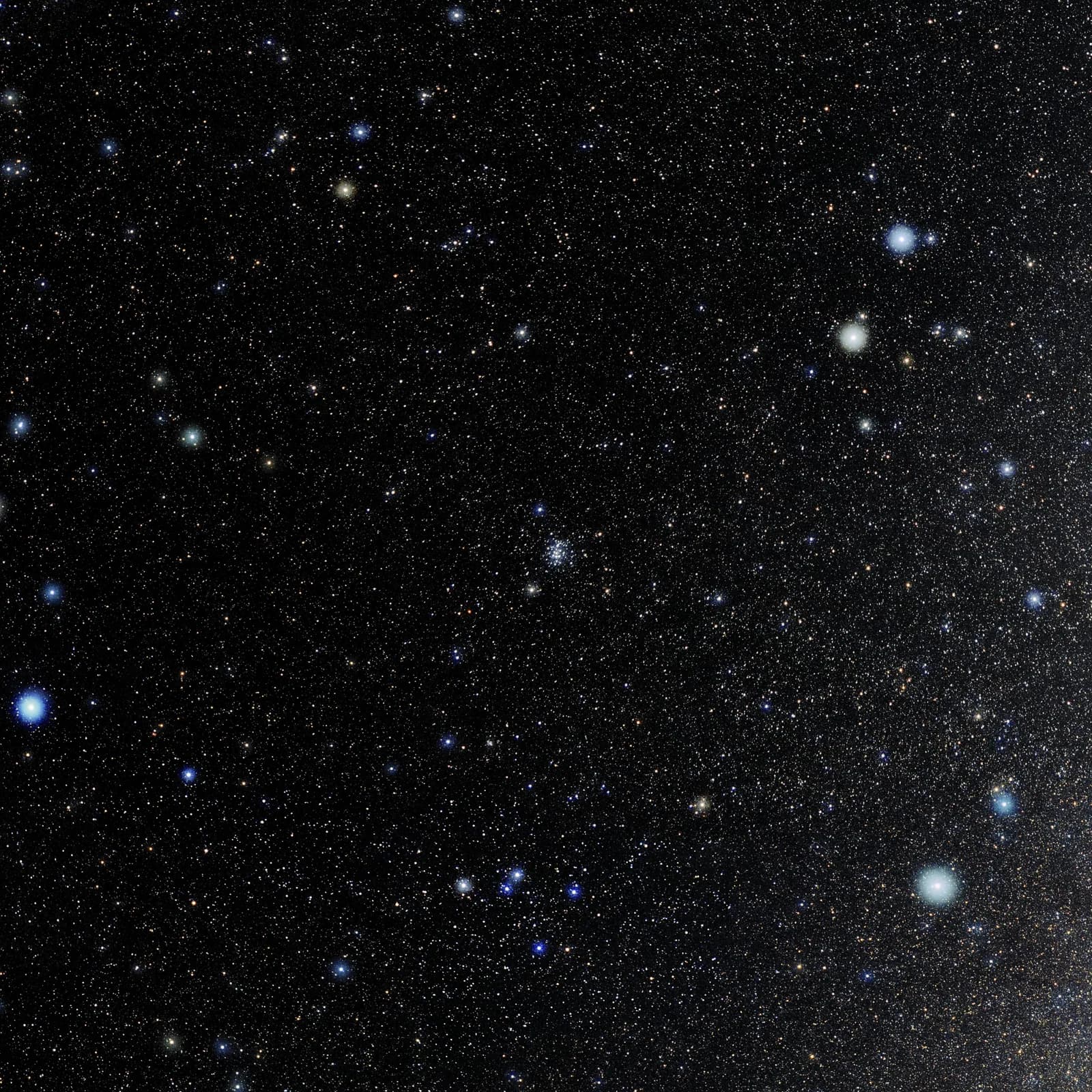
- Main object
- Praesepe, or the Beehive — M44
- M44 type
- Open star cluster
- Where to look
- Between Gemini and Leo
A constellation that needs dark skies
Cancer lies between the more conspicuous Gemini and Leo. Under city light pollution, its pattern can almost disappear. The map is not wrong: faint stars are the first to vanish against a bright background.
Look for the region between Pollux and Regulus, then check a magnified map. Do not rush to draw every line at once: first identify the area, then confirm the positions of a few stars.
Praesepe: from an ancient cloud to a group of stars
Observers knew M44 long before modern telescopes. It was described as a hazy patch; the names Praesepe, meaning manger, and Beehive evoke different images of the same star cluster.
Under dark skies, M44 can be spotted without optical aid, while binoculars help resolve its stars. A wide field of view is particularly useful here: magnification is not always more important than seeing the whole object.
What to do when Cancer is on the chart but absent from view
Begin with bright neighbours rather than guessing every faint point. Locate Pollux toward Gemini and Regulus toward Leo, then compare the gap between them with a wide chart. Once those references are confirmed, Cancer’s missing pattern tells you about the conditions: the direction is established, but contrast is insufficient. Do not substitute unrelated nearby stars just to force a match.
Check for a nearby lamp and whether the region is close to the horizon. For a faint pattern, observing conditions matter as much as a working phone. Study a photograph first, memorising two or three reference points around M44, then return on a darker evening. Separating preparation from outdoor observation avoids the frustration of searching for every line at once.
Why the Beehive deserves a wide field
M44 covers a substantial patch of sky, so high magnification does not always help reveal its pattern. A tight field can show several stars while losing the impression of a cluster. Begin by comparing the outline, the density of points, and the surrounding background in a wide field. Select a smaller region afterwards if you want a closer look.
Detailed images of M44’s outskirts can also include background galaxies. Sharing a frame does not make them cluster members. Separate information about the stellar group from descriptions of other objects along the same direction. Cancer makes a good example: a modest naked-eye pattern and a rich telescope image show different depths rather than contradicting one another.
Turning the search for Cancer into a small experiment
Prepare two sketches of the same field: one with only the most reliable references and another including faint stars you want to test. Do not copy the entire atlas. Afterwards, mark which sketch better matches the view. This produces a personal visibility record for the region that can be compared with another night without complicated measurements.
Compare attempts when Cancer is at a similar height. A low view above illuminated buildings and a high view over a dark area introduce several possible explanations for improvement. For a first experiment, record the time, moonlight, and interfering lights. Even a brief note is more useful than concluding that the phone is showing the wrong sky.
Finish by separating two results: locating Cancer’s direction and detecting M44. These are independent tasks. You can know the cluster’s address confidently even when the background prevents detection. Keep that result: next time you will start with a verified route and concentrate on the faint patch instead of relocating the whole area between its neighbours. Keep both sketches so you can compare an actual improvement rather than rely on memory alone.
What the star pattern looks like
Questions about the sign and constellation
Why is Cancer hard to see from a city?
Its pattern lacks guide stars as bright as those in neighboring Gemini and Leo. Light pollution hides the faint points. Start with a map and choose a darker location with an open sky.
Are Praesepe and the Beehive different objects?
No. Both names refer to the open star cluster M44, also known as Praesepe.
Sources and photograph
The sources below support the astronomical information. The horoscope is original COSMO360 entertainment content; it is not a conclusion drawn by NASA, the IAU or observatories.
- NASA Night Sky Network: Cancer's subtle treasures
- IAU / Sky & Telescope: constellation chart for Cancer
- NASA Space Place: constellations, astronomy and astrology
- NASA Night Sky Network: zodiac signs and constellations
- Original photograph — E. Slawik/NOIRLab/NSF/AURA/M. Zamani
- CC BY 4.0 terms
- Chart: HYG 4.1 catalog, J2000 coordinates