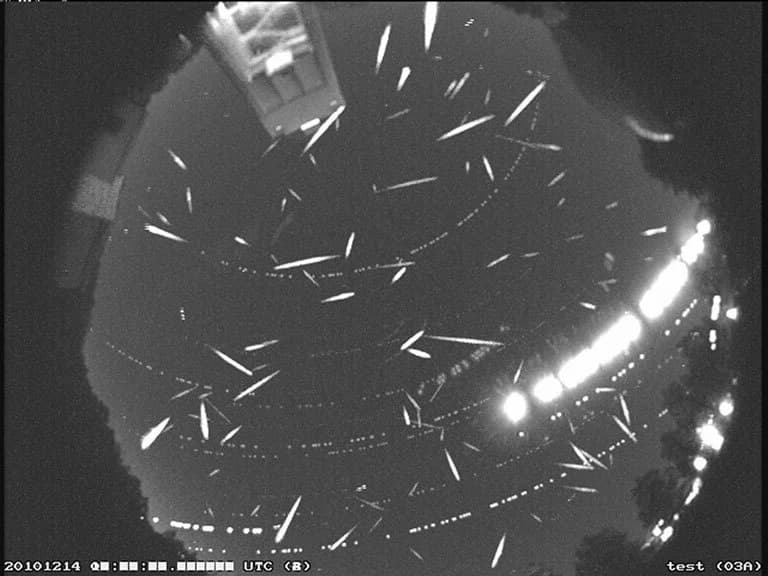
The Geminids reach their maximum on December 14, 2026. In Russia, set aside the night of December 13–14 and, weather permitting, the following night. The young Moon should leave good conditions after it sets, and this shower usually offers worthwhile viewing before midnight. But the figure of 150 in a forecast is a standardized activity measure, not a guaranteed meteor count above your yard.
- The IMO’s nominal maximum is December 14 at 14:00 UTC, or 17:00 Moscow time.
- The Geminids have a broad maximum: choose clear, dark hours near the peak.
- The radiant lies in Gemini, but meteors should be watched across a wide area of sky.
- No telescope is needed; darkness and time outdoors help more than magnification.
When do the Geminids peak in 2026?
The International Meteor Organization’s calendar lists activity from December 4 to 20, with a nominal maximum on December 14 at 14:00 UTC. That is 17:00 on the same date in Moscow. NASA and the American Meteor Society give December 4–17 for their activity window. The difference concerns the weaker edges of the shower; the main peak date agrees.
The maximum is not a spotlight switched on briefly. IMO notes that previous peak timings span an interval corresponding to December 13 at 21:00 UTC through December 14 at 18:00 UTC in 2026. The nominal time helps compare forecasts, but local darkness and radiant height matter more for an observer. A daytime nominal peak does not make nighttime viewing pointless.
An earlier chance to practice comes with the 2026 Leonids on November 17–18. Their IMO forecast has a ZHR of about 15 rather than the Geminids’ 150, and the useful window with a high radiant shifts toward morning. The showers call for different expectations: a successful November session need not deliver December’s meteor rate.
Which night and hours should you choose in Russia?
A practical first choice is the night of December 13–14, especially its second half, when Gemini stands higher. If that night is cloudy, also check the evening of December 14 and the following night. Activity around the broad maximum can remain worthwhile, although equal results on both nights cannot be promised. A clear hour near the peak is more useful than several overcast hours at its nominal time.
At middle northern latitudes, viewing can start around 21:00–22:00 local time with an open patch of sky. The radiant then climbs and reaches the upper part of its daily path around 02:00. This is a general guide rather than a single timetable for all of Russia: longitude within a time zone, latitude and the local horizon change the conditions. Check a sky chart for your city before going out.
Will the Moon interfere?
Near the peak, the Moon will be a waxing crescent. Unlike a full Moon, it will not brighten the entire night: after it sets, dark hours can coincide with a high radiant. Moonset must be checked for your location and date, so a time quoted in a British or American guide cannot simply be applied to Moscow, Yekaterinburg or Vladivostok.
Why will not everyone see 150 meteors per hour?
IMO lists a ZHR of 150 for the Geminids. This zenithal hourly rate is standardized to a dark sky and a radiant overhead. A real observer has a different radiant height, loses faint meteors to light pollution and occasionally looks away. The headline figure does not mean that a visible streak must appear every 24 seconds.
NASA’s page gives a practical dark-sky expectation of 40–50 meteors per hour and describes ideal conditions separately. This helps set expectations: several quiet minutes do not mean the shower is over. A brief outing is a poor activity sample. Allow time for your eyes to adapt, then watch for at least half an hour if the weather and your comfort allow.
Where to look: Gemini and the radiant
The name comes from the constellation Gemini: if meteor trails are extended backward in your imagination, they meet around a region called the radiant. The constellation’s stars lie far beyond the Solar System and do not release these particles. The shared point is a perspective effect: nearly parallel paths appear to spread out, just as railway tracks appear to meet in the distance.
You do not need to stare at Castor or keep Gemini inside a telescope’s field. Trails can look short close to the radiant; longer streaks appear farther away. Settle where you can see a broad expanse of sky without a lamp or bright screen shining into your eyes. If you cannot yet identify Gemini, identifying the constellation from a photo taken before your session can help.
Where to watch and what to bring
Start with a light-pollution map: find an accessible, open location with less artificial lighting, then check clouds and transparency. A favorable map color does not remove fog, snowfall or a lamp behind the next fence. There is no universal distance from a city that guarantees a good sky; urban size and the direction of travel vary greatly.
For naked-eye watching, comfort, warmth and patience matter more than optics. A reclining chair, insulation underneath and clothing suited to staying outdoors are useful. NASA recommends allowing about 30 minutes for dark adaptation. Repeatedly checking a bright phone interferes with that process; study the chart and forecast beforehand. If you become cold, end the session or take a break somewhere warm.
Where do the Geminids come from, and what is Phaethon?
The shower is associated with the small asteroid 3200 Phaethon. Earth crosses particles spread along its orbit each year. Entering the atmosphere at roughly 35 kilometers per second, they produce luminous meteors. The asteroid itself does not have to pass close to Earth in December. As with Apophis, it helps to distinguish a celestial body, its orbit and an event seen from Earth.
The origin of the full particle supply is still being studied. An ordinary dust tail alone is not an adequate explanation: research reported by NASA in 2023 linked Phaethon’s observed near-Sun tail to sodium gas. That gas itself does not provide the rocky grains in the December shower. A disruptive event in the past remains one possible explanation for the large debris supply; the association with Phaethon does not mean the mechanism is fully settled.
The Geminids make an interesting comparison with the November Taurids. The Geminids are linked to Phaethon, while Taurid orbits point to a connection with the short-period Comet Encke. The Encke complex has several branches, and researchers compare meteor trajectories to understand how they formed.
Sources
- IMO — 2026 Meteor Shower Calendar, Geminids section
- NASA — Geminids: shower background and viewing advice
- American Meteor Society — 2026/2027 calendar
- Royal Museums Greenwich — the Geminids in 2026
- NASA — Phaethon’s sodium tail and the puzzle of the debris stream
- Egal et al.: observational study of the Taurid complex
Questions and answers
Are the Geminids on December 13 or 14?
The nominal maximum is December 14, 2026. Plan nighttime viewing for December 13–14; check the following night if needed. The maximum is broad, and the actual display depends on conditions and shower activity.
Can the Geminids be seen from Moscow?
Bright meteors can be visible under a clear, open sky, but urban lighting hides faint ones. A dark location with a wide view improves the chances. Check the forecast for the specific night closer to the date.
Do you need a telescope for the meteor shower?
No. Meteors appear briefly in different parts of the sky. Naked-eye watching provides a broad view, while magnification narrows the field.
Are these falling stars or meteorites?
The luminous streak is a meteor, produced by a particle entering the atmosphere. The stars stay where they are. A meteorite is material that reaches the ground; a bright meteor does not by itself imply a meteorite fall.
Are 150 meteors in an hour guaranteed?
No. ZHR is a rate standardized to reference conditions. Your count depends on radiant height, light pollution, clouds, field of view and observing time. Even under dark skies the actual count can be substantially lower.