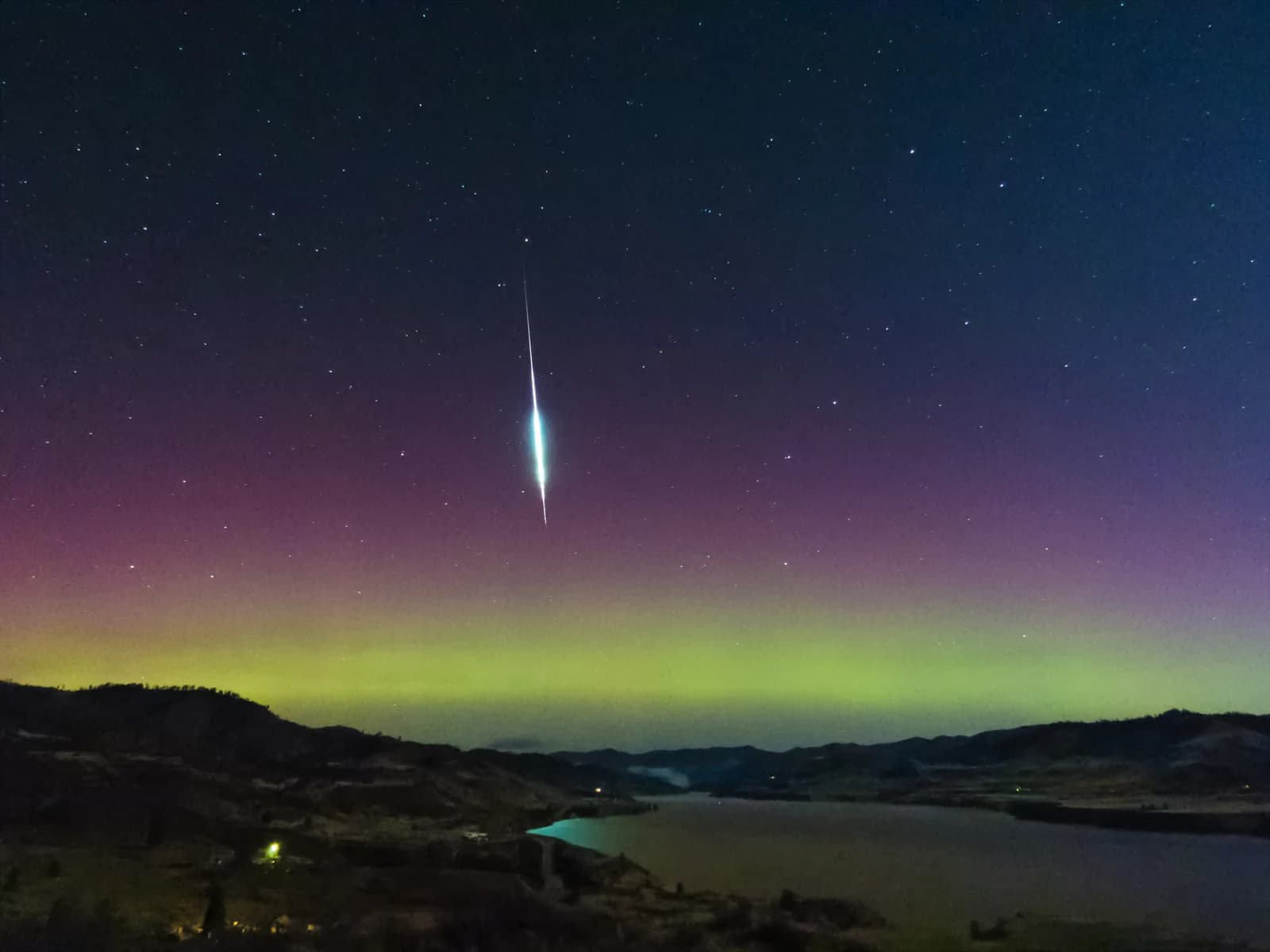
The two Taurid peaks are a week apart in November. Look for the Southern Taurids overnight on November 4–5 and the Northern Taurids on November 11–12. Both showers produce relatively few meteors, with long pauses between streaks. The appeal is a chance to catch a rare bright one. In 2026, there are hours around both peaks when the Moon is below the horizon.
- Southern Taurids — November 4–5. Start late in the evening and make use of the dark hours before moonrise.
- Northern Taurids — November 11–12. The thin waxing crescent sets in the evening, while the radiant climbs high around midnight and into the early hours.
- A few meteors per hour is typical of the Taurids. No autumn encounter with the denser part of the resonant swarm is predicted for 2026, though individual fireballs remain possible.
When the Taurids peak in 2026
The International Meteor Organization (IMO) puts the November peaks on November 5 for the Southern Taurids and November 12 for the Northern Taurids. The corresponding observing nights are November 4–5 and 11–12. NASA’s November skywatching guide also gives November 5 and 12 as approximate dates. Taurid activity changes gradually, so a clear night nearby can yield more than an overcast peak night.
In the IMO working list, the Southern Taurids are active from September 20 to November 20 and the Northern Taurids from October 20 to December 10. The southern branch also has a broad period of higher activity around mid-October. Calendars can emphasize different features of its activity profile. Both branches are active in early November, and you can see meteors from each on the same night.
What time to watch in Russia
A practical window for Moscow, Novosibirsk, and Vladivostok is roughly 11 p.m. to 2 a.m. local time. The radiants are well up by then, and on the dates in question the Moon has either set or not yet risen. That window covers the radiants’ passage near their highest point in the southern sky. With an open horizon, you can start earlier or keep watching after 2 a.m.
The waning crescent rises on November 5, during the Southern Taurid peak night. U.S. Naval Observatory (USNO) ephemerides give moonrise at 2:53 a.m. in Moscow, 3:42 a.m. in Novosibirsk, and 3:21 a.m. in Vladivostok. A bright meteor may still be visible after moonrise, especially if you look in the opposite direction.
Conditions are simpler for the Northern Taurids. The new Moon occurs on November 9 at 07:02 UTC, or 10:02 a.m. Moscow time. On the evening of November 11, the young crescent sets at 4:40 p.m. in Moscow, 5:41 p.m. in Novosibirsk, and 6:36 p.m. in Vladivostok. By late evening there is no moonlight. Check your own city’s moonrise and moonset if you live elsewhere. Terrain and your view of the horizon also affect when you see the Moon.
Where to look and how to find Taurus
Across much of Russia in November, Taurus rises in the east in the evening and passes high above the southern horizon around midnight or in the early hours. Look for orange Aldebaran and the compact Pleiades cluster. If Orion has risen, extend the line of its Belt upward toward Aldebaran. The Pleiades help you get your bearings in the adjoining part of the sky.
A radiant is the area toward which meteor paths converge when you trace them backward across the sky. Nearly parallel particle paths appear to converge in perspective, like railway tracks in the distance. The two November radiants are close together and shift slightly from night to night. The northern radiant lies north of the southern one on a sky chart. The names describe that relative position, so both showers are visible from Russia.
To look for meteors, shift your gaze from Aldebaran to a broad, dark patch of sky away from the radiant. Near the radiant, you see the paths nearly end-on, so the streaks look short. At an angle to it, the same meteor could trace a noticeably longer line. Keep as much unobstructed sky in view as you can.
How many meteors per hour can you see?
The IMO working table gives a ZHR of seven for the Southern Taurids and five for the Northern Taurids. ZHR is a standardized hourly rate for one shower under dark skies with the radiant overhead. In Russia, both radiants pass south of the zenith. Haze, trees, and city lights further narrow your view or hide faint meteors. Expect a few meteors per hour at a good site, some of which may belong to other showers.
The American Meteor Society’s (AMS) weekly outlook illustrates the gap between standardized and observed rates. Around the turn of October to November, it estimated roughly three Southern and two Northern Taurids per hour from dark Northern Hemisphere sites when the radiants were well placed. Meteors arrive irregularly. Even under clear skies, you might see nothing for half an hour and then catch two streaks in quick succession.
Why the Taurids are known for bright fireballs
In the IMO table, particles in the two branches encounter Earth at roughly 27–29 km/s. Leonids, by comparison, enter the atmosphere at about 71 km/s. A Taurid often appears slow beside faster meteors, although its apparent speed also depends on its distance and the angle from which you see its path.
A larger fragment can produce a brief flash brighter than Venus. An exceptionally bright meteor is called a fireball. The AMS uses the term “bolide” more narrowly for a fireball with a bright terminal flash, while Russian coverage commonly uses it more broadly. Either way, the shower count also includes faint streaks. An hourly rate of five or seven refers to all meteors from that branch under the specified conditions.
Will the Taurid swarm intensify in 2026?
Some particles in the complex are trapped in a 7:2 orbital resonance with Jupiter. They go around the Sun about seven times for every two Jupiter orbits. Repeated gravitational perturbations help keep a denser group of particles within a limited stretch of their orbit. When Earth passes close enough to this group, bright Southern Taurids can become more numerous. A well-studied episode occurred in autumn 2015.
A study by astronomer Aurélie Egal and colleagues identified 2025 and 2032 as potential windows for autumn encounters with the swarm. Its reference to 2026 concerns the complex’s daytime branches, active in a different season. The regular outlook for November observers remains modest. A single bright meteor is possible even in a year without an encounter with the denser part of the swarm.
How the Taurids are linked to Comet Encke
Comet 2P/Encke follows a highly elongated orbit. NASA’s Jet Propulsion Laboratory (JPL) database gives an orbital period of about 1,210 days, or 3.3 years, and a closest distance to the Sun of about 0.34 astronomical units. As a comet approaches the Sun, warmed ice releases gas that carries particles away. Some debris stays on similar orbits, where trails spread out over time and evolve under the gravity of the planets.
Each year Earth crosses parts of the debris complex associated with Encke. The comet only had to leave material on suitable orbits in the past. How all the branches formed remains a subject of research. Besides long-term dust release, models consider possible breakups of a larger progenitor. Similar orbits help identify candidates for a common origin, but tracing the origin of any individual particle is difficult.
How to spend an hour watching
Choose a site with a wide view and no streetlamp in your line of sight. A light pollution map helps you find the darker side of town in advance. Once there, also check for low clouds and light along the horizon. Give your eyes 20–30 minutes to adjust. On a cold November night, reclining on a mat or in a chair makes it easier to keep a large patch of sky in view.
If you see an especially bright flash, record the time, time zone, location, and direction. Try to remember where the streak began and ended relative to the stars or the horizon. You can submit those details through the AMS/IMO reporting form. When the same event is photographed or described from several places, researchers can more easily reconstruct its path through the atmosphere and check whether it belongs to the Taurids.
Sources
- IMO: Taurid peak dates in 2026
- IMO: 2026 calendar, radiants, speeds, and ZHR
- NASA: November 2026 skywatching guide
- AMS: meteor activity outlook for October 31–November 6, 2026
- USNO: local moonrise and moonset
- USNO: Moon phases in 2026
- USNO: Moscow calculation for November 5
- AMS: fireballs, bolides, and observer reports
- Egal et al.: observational study of the Taurid complex
- Spurný et al.: Taurid fireballs in 2015
- JPL: orbital parameters for Comet 2P/Encke
- Egal et al.: modeled orbital history of Comet Encke
- NASA: finding Aldebaran and the Pleiades
Questions and answers
Which night is best for the Taurids in 2026?
Watch for the Southern Taurids on November 4–5 and the Northern Taurids on November 11–12. If the weather is equally good and you can pick only one night, November 11–12 is convenient because the thin crescent will already have set by late evening.
Can you see the Taurids after November 12?
Yes. The IMO calendar lists activity through November 20 for the Southern Taurids and December 10 for the Northern Taurids. Generally, the farther you are from the peak, the fewer shower meteors you will see.
Do you need a telescope?
Watch with the naked eye. It takes in a wide area where both short and long streaks can appear. Binoculars are useful later if you want a closer look at the Pleiades.
Does a bright flash mean a meteorite fell?
Brightness tells you how much light reached the observer. To assess whether any meteorites might have reached the ground, researchers need the trajectory, speed, and altitude at which the light went out.
Which meteor shower comes after the Taurids?
Look for the Leonids in mid-November and the Geminids in December. They have different radiants and favorable viewing times.