When World Space Week takes place
World Space Week runs every year from October 4 through October 10, inclusive. The dates are the same in 2026. The UN General Assembly proclaimed the week on December 6, 1999, in Resolution 54/68, to highlight the contribution of space science and technology to people's lives.
It is an opportunity to approach a complex subject through an understandable question: how does a satellite get above Earth, what can a telescope see, or why study the Moon? You can start with just one of these. What matters about a good lecture, lesson, or conversation is not the number of technical terms, but whether it inspires a desire to understand more.
Why October 4 and 10 were chosen
On October 4, 1957, the Soviet Union placed Sputnik 1, Earth's first artificial satellite, into orbit. The launch became one of the defining milestones at the beginning of the Space Age. The week's other endpoint, October 10, commemorates the Outer Space Treaty entering into force in 1967.
A common mistake arises here: the treaty opened for signature on January 27, 1967, and entered into force on October 10. The week's two dates connect a technical achievement with international rules. They invite us to see space exploration as both an engineering challenge and a shared endeavor requiring cooperation.
The 2026 theme: Rocket Revolution
The official theme of World Space Week 2026 is Rocket Revolution. It focuses on changes in access to space: the growth of commercial launches, reusable technologies, and participation by new teams. Attention turns not only to the flight itself, but also to who gains the opportunity to send a mission.
It helps to treat the word “revolution” as an invitation to compare approaches. How does an expendable rocket work? Which parts can be recovered? Why does one spacecraft need a small launcher while another requires a heavy one? These questions add more substance than a simple list of records. The week's theme does not mean that all rockets are already reusable or that every launch is now equally accessible.
How a rocket flies where there is no air
A rocket does not need to push against air. Its engine ejects mass in one direction, and the rocket gains momentum in the opposite direction. This follows Newton's third law and the conservation of momentum. The absence of an atmosphere therefore does not prevent rocket propulsion.
A chemical rocket carries both fuel and oxidizer on board. It does not depend on oxygen in the surrounding air in the way an air-breathing jet engine does. When hot gas forms in the combustion chamber, the nozzle directs and accelerates the flow, producing thrust.
A classroom discussion can start with a simple model: imagine someone on a freely rolling platform throwing an object forward. The platform rolls backward. The analogy helps explain momentum exchange, but does not replace an explanation of a real engine. You can then draw a rocket diagram and label the propellant tanks, engine, stages, and payload.
What rocket reusability changes
Recovering a rocket stage is an engineering challenge in its own right. Its motion must be controlled after separation, it must withstand loads, and its landing must finish precisely. ESA's Themis development shows the systems involved: landing legs, aerodynamic controls, lightweight tanks, electronics, and flight algorithms.
Themis is a demonstrator for recovery and reuse technologies. Its design includes a vertical landing and a restartable Prometheus engine. A demonstrator is intended for testing; it should not automatically be considered an operational, mass-produced launch vehicle.
When reading news, ask more precise questions: did the entire rocket return, or just one stage? Was it a test flight or a routine mission? Was the recovered vehicle used again? This makes it easier to distinguish an important achievement from an overly broad headline. It is also useful to check which results have been demonstrated through observations and which remain project goals.
How to celebrate Space Week at home or at school
You do not need to begin with a large event. For a first mini-project, choose one question and set aside an evening for it. Watch an archival launch recording, pause at stage separation, and try to explain what is happening. Then compare your explanation with reference materials from a space agency.
Another option is a journey through a star atlas. Find a familiar constellation, explore its photograph, and compare the distances to several stars. Note how the map's diagram differs from the photograph and what each representation helps you see. This turns looking at a beautiful sky into a small investigation.
For a school lesson, assign teams different roles: one explains the physics of motion, another draws the launch vehicle, and a third examines the historical dates. At the end, each team should name its source and one question that remains unanswered. These are ideas from the COSMO360 editorial team, rather than the official 2026 event schedule.
If you want to join a gathering or lecture, look for current announcements from organizers, your local planetarium, museum, or astronomy club. Check the date, time zone, format, and whether registration is required. A city's program may change; last year's announcement does not confirm an event this year.
What to take with you after October 10
The week ends, but your chosen question can become a habit. Keep a short journal: which news story interested you, where the information came from, and what you can now explain in your own words. One thoughtful entry is enough to make your next reading more attentive.
Begin with the next small step: explore the Moon's origins, compare planets, or learn the story behind a star photograph. Space feels closer when a striking image becomes a process you can understand. That transition from wonder to investigation can be your personal outcome from World Space Week.
Sources
- UN: World Space Week and the 2026 theme
- UNOOSA: dates of adoption, signature, and entry into force of the Outer Space Treaty
- NASA: how a rocket works
- ESA: Themis: stage recovery and reuse
- World Space Week Association: the organizers' official website
- NASA: archival Artemis I launch, November 16, 2022
- NASA: Sputnik 1 and the beginning of the Space Age
- UN: April 12 and Yuri Gagarin's first flight
Image
Questions and answers
What are the dates of World Space Week in 2026?
October 4–10, 2026, inclusive. The dates remain the same every year.
What is the theme of World Space Week 2026?
Rocket Revolution. It focuses on changes in access to space and launch technologies.
How does it differ from Cosmonautics Day?
World Space Week lasts seven days in October and covers a range of educational topics. Cosmonautics Day is celebrated on April 12, the anniversary of Yuri Gagarin's first flight.
Do I need a telescope to take part?
No. You can start with a lecture, an archival launch video, a star map, or a physics activity of your own.
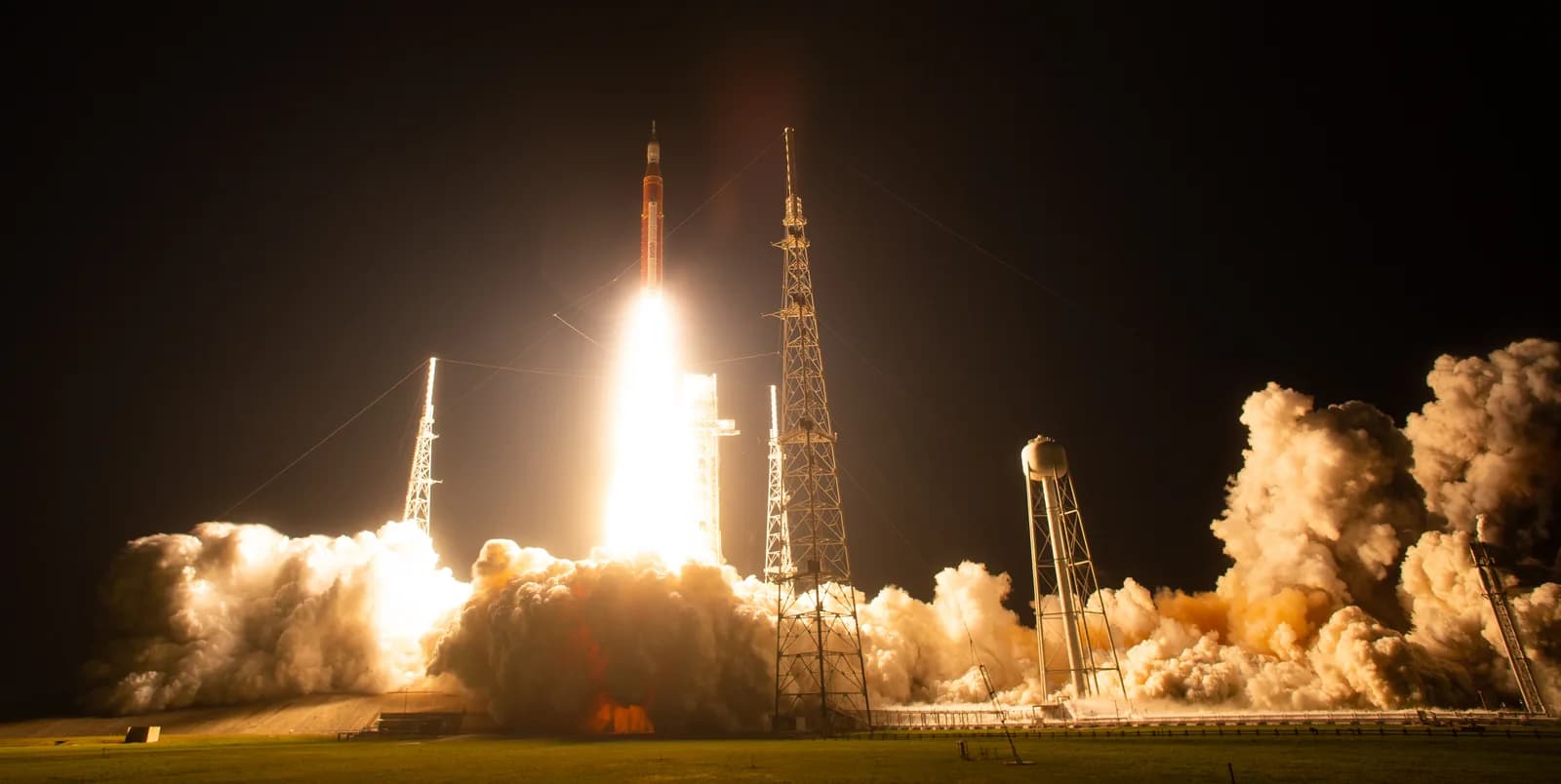
Is the Artemis I launch on the cover from 2026?
No. It is a genuine archival photograph of the November 16, 2022 launch. It illustrates space launches and is not a photograph of events during the 2026 week.